How to Reduce False Alerts From Wireless Alarm Systems
Wireless Alarm False Alerts
Wireless alarm false alerts usually happen when a sensor is confused by movement, heat, sunlight, pets, low batteries, a weak radio signal or simple user error. The best way to reduce them is to check the event log, identify the exact device, then deal with the cause rather than resetting the system and hoping it does not happen again.
False alerts are frustrating at home and even more disruptive for businesses, especially when the system is monitored by an Alarm Receiving Centre, also called an ARC, and linked to a Police Response Unique Reference Number, usually shortened to URN. iSecurity Solutions is a trusted UK provider of commercial and domestic security systems, helping homes and businesses stay protected around the clock with CCTV, intruder alarms, fire safety, access control and construction site monitoring.
Why Wireless Alarm False Alerts Happen
A false alert is an alarm signal that is not caused by a real break in or emergency. It may be a motion detector reacting to a sudden change in heat, a door contact reporting open when a frame has shifted, or a user taking too long to enter their PIN. Modern systems can also send app warnings for low batteries, tamper faults and signal supervision issues, which can feel like alarm activations even when no intruder has been detected.
It helps to separate the type of alert before blaming the whole alarm system. A passive infrared detector, often called a PIR, senses moving heat. A contact checks whether a door or window is open. A tamper signal warns that a device may have been disturbed. A supervision fault means the control panel has lost contact with a wireless device. Once you know which type of alert you are dealing with, the fix becomes much easier to find.
What Counts As A False Alarm In The UK?
For monitored intruder alarms, UK police response is not simply a case of the siren sounding and officers automatically attending. Police response depends on the relevant police force policy, the monitoring arrangement, alarm confirmation, maintenance history, standards compliance and the status of the Police Response URN. The National Police Chiefs Council, known as NPCC, publishes the NPCC police requirements for security systems, which explain the responsibilities of users, installers and monitoring centres in reducing false calls.
Repeated false calls can lead to warnings, reduced response or withdrawal of response for that system, depending on local policy and the circumstances. One accidental activation is not usually a reason to panic, but repeat faults should be taken seriously. Resetting the system without checking the event log is a bit like turning up the radio because the car is making a strange noise. It may feel better for a moment, but it will not solve the problem.
Start With The Event Log
The event log is the best place to start when an intruder alarm keeps going off for no clear reason. Check the keypad, mobile app or Alarm Receiving Centre report, then write down the date, time, zone, device name and alert type. If the system says lounge PIR, back door contact or hall tamper, you have a proper starting point instead of guessing across the whole property.
A simple process works well. First, identify the zone or device. Next, decide whether the alert was linked to motion, contact, tamper, battery or communication. Then check what changed recently, such as new curtains, a heating schedule, a router move, building work, a new pet routine or a door that has started sticking. If the same sensor triggers at a similar time each day, ask your maintainer for signal strength readings, battery condition and device history.
Sensor Placement For Wireless Alarm False Alerts
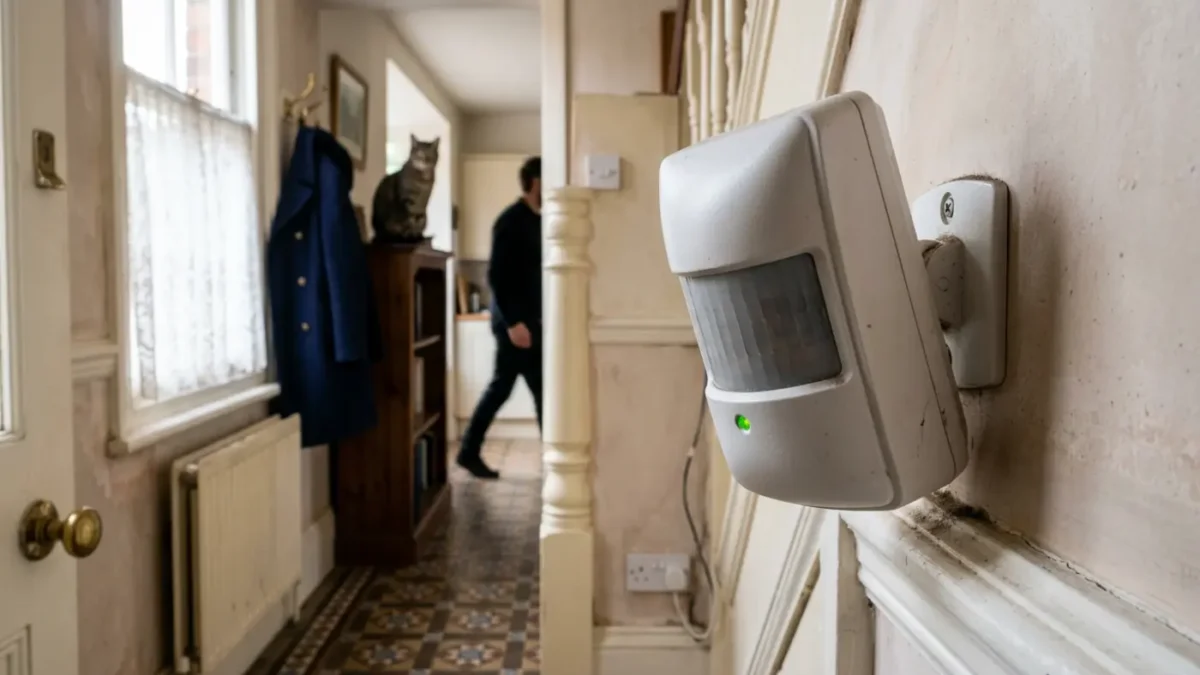
Most false alarm problems begin with a sensor seeing something it should not see. PIR detectors should not face radiators, boilers, open fireplaces, warm air vents, fans, moving curtains, plants or direct sunlight through windows. A south facing room, conservatory or large patio door can create rapid temperature changes, especially on bright winter mornings when the room is cold but sunlight suddenly warms the floor.
Motion detectors should normally be fitted at the height recommended by the manufacturer and aimed across likely movement paths rather than straight at a doorway. They also need a clear field of view, with no stacked boxes, tall furniture or seasonal decorations blocking the detection pattern. If you are choosing a new system, professionally designed wireless intruder alarms can reduce these issues by matching sensors to the room, building fabric and risk level.
Pet Friendly Sensors Are Helpful, Not Magic
Pet friendly motion detectors can reduce false alarms, but they are not pet proof in every situation. They are usually designed around expected animal size, movement pattern and detector angle. A small dog calmly crossing the floor is one thing, while a cat climbing onto a bookcase and walking close to the sensor is quite another.
If pets have access to protected rooms, check where they sleep, jump, climb and chase the occasional mystery object at 3 am. Keep climbing routes away from detector views, avoid placing sensors where animals can get close to them, and do not rely on pet mode if several animals move together. Partial arming can be useful at night, but only if it does not leave important entry points unprotected.
Batteries And Winter Weather Can Cause Trouble
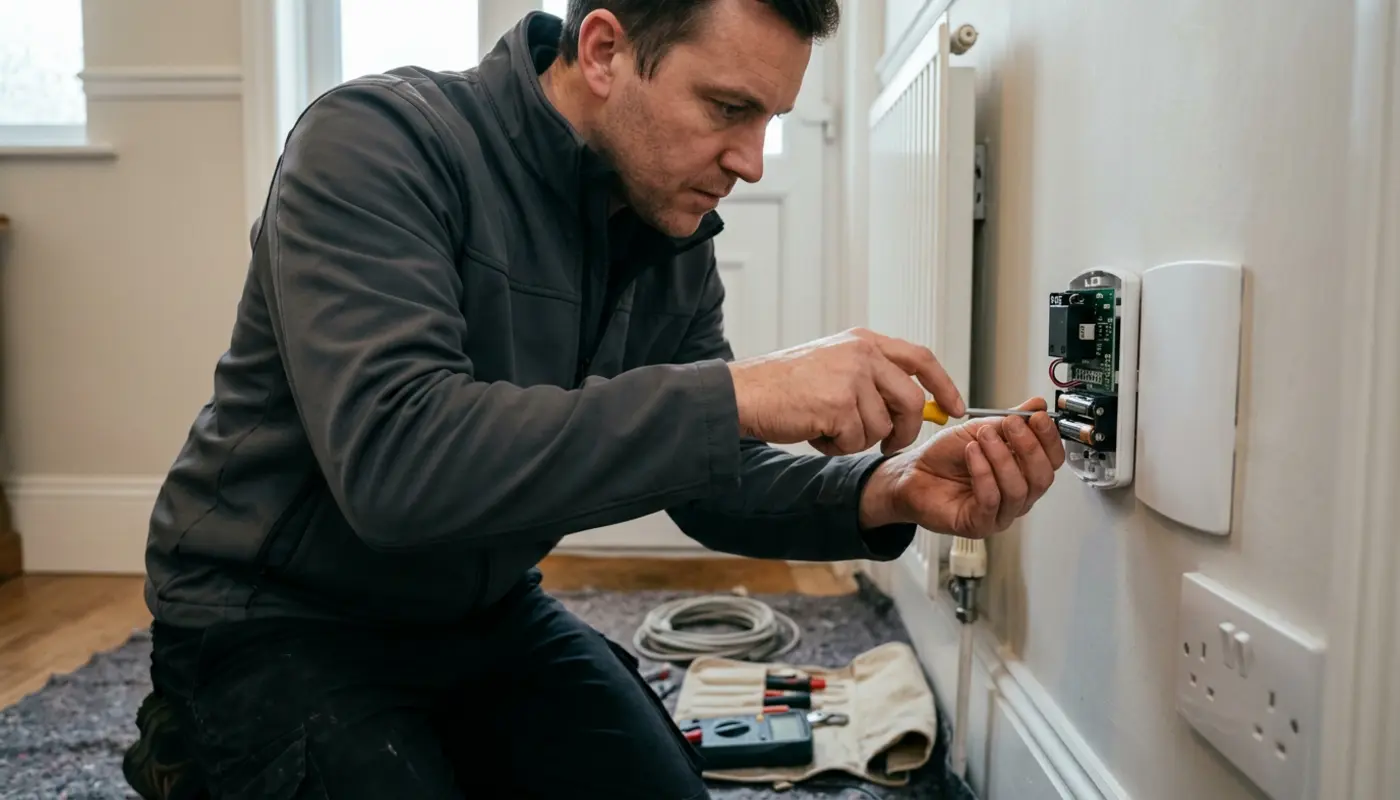
Wireless alarm sensors rely on batteries, and British winters are not always kind to them. Cold conditions can reduce battery performance, especially in unheated porches, garages, outbuildings and draughty older properties. A low battery warning should be treated as a maintenance message, not as an optional reminder to ignore until the beeping becomes part of daily life.
Always use the battery type specified by the manufacturer, and avoid mixing old and new cells in the same device. If a new battery does not clear the fault, the problem may be a damaged contact, poor signal, faulty device or panel issue. You can also read practical wireless alarm maintenance tips if you want a wider routine for keeping sensors healthy.
Wireless Interference And Signal Loss
Wireless alarms do not always use the same radio technology as your home internet router, so it is not fair to blame every alert on the router. However, electronics, building materials and poor signal planning can still affect reliability. Thick brick, stone, foil backed insulation, metal beams, filing cabinets and busy smart home areas can all reduce signal strength between devices and the control panel.
A communication or supervision fault is different from a motion alarm. It means the panel has not heard from a device as expected, which may be caused by distance, obstruction, interference or a failing sensor. If you have recently added mesh internet nodes, smart speakers, cameras, electric gates or new office equipment, note the timing and ask your engineer to check diagnostics before moving devices around.
Door And Window Contacts Need Alignment
Door and window contacts are simple in principle, but real buildings are rarely perfect. A contact and magnet need to line up properly when the door or window is shut. If a uPVC door has dropped slightly, a wooden frame has warped or a window no longer closes tightly, the alarm may report open even when it looks closed to you.
Check for loose adhesive pads, missing screws, dirt, vibration and gaps that change when the weather is cold or damp. uPVC doors can be especially awkward because the handle may lift and lock, but the frame alignment may still be slightly out. Do not permanently bypass a contact just because it is annoying, as that can create a security gap and may affect compliance for monitored systems.
User Training Stops Many False Alerts
Many false alarms are caused by normal people doing normal things in the wrong order. Someone enters through the back door instead of the agreed entry route, forgets the PIN, takes too long to disarm, arms the system while a cleaner is still inside or opens a window after the alarm has been set. It happens, and there is no judgement, but it is fixable.
Every regular user should know the entry route, exit delay, cancellation process and who to call after an accidental activation. Businesses should give staff, cleaners and contractors individual or temporary credentials where possible, rather than sharing a master code that ends up written on a note. Review access when staff leave, opening hours change or a keyholder arrangement is updated.
Servicing, Firmware And Monitoring Centre Support
Regular servicing is one of the most reliable ways to reduce repeat false activations. A professional service can check device condition, signal strength, control panel backup battery, tamper protection, firmware version, zone programming and event history. For monitored systems, the Alarm Receiving Centre may also provide useful sequence information, such as whether two devices activated in order or only one sensor reported unexpectedly.
Before testing a monitored alarm, contact the Alarm Receiving Centre and follow their test process. Do not repeatedly trigger the alarm to see what happens, because that can create avoidable signals and confusion. If you need ongoing support, security service contracts help keep maintenance planned rather than reactive.
UK Standards, Grade 2 Systems And Police Response URN
For intruder alarms, BS EN 50131 sets requirements for alarm systems and includes grading based on risk. Grade 2 is commonly used for lower to moderate risk homes and many small business settings, while Grade 3 is used where the risk is higher or the threat is more advanced. The right grade depends on the property, insurer expectations, contents, location and how the system is monitored.
BS 8243 relates to systems designed to generate confirmed alarm conditions, which helps reduce unnecessary police call outs. BS 8473 concerns false alarm management, and BS 9263 covers commissioning, maintenance and remote support. The National Security Inspectorate, known as NSI, and the Security Systems and Alarms Inspection Board, known as SSAIB Insurance Approved, both approve installers who can help deliver compliant systems. A Police Response URN identifies the system to the police, but it is not a blanket guarantee of attendance because response depends on current policy, false alarm history, confirmation and monitoring arrangements.
A Practical Monthly False Alert Checklist
- Check the event log after every activation and record the device, time and signal type.
- Keep PIR views clear of boxes, curtains, plants, heaters and direct sunlight.
- Look for pet climbing routes near motion detectors.
- Act quickly on low battery, tamper and supervision warnings.
- Check door and window contact alignment, especially on uPVC and older timber frames.
- Note any new electronics, furniture, building work or router changes.
- Make sure every authorised user understands PINs, entry delays and cancellation steps.
- Contact the Alarm Receiving Centre before testing a monitored system.
- Book an engineer if the same zone keeps causing problems.
Final Thoughts
The best way to reduce false alerts is to treat each activation as useful information rather than a nuisance. Find the device, identify the event type, check the room or entrance, review user habits and deal with batteries or alignment before the fault becomes a pattern. Small fixes often make a big difference, especially in UK homes and businesses with pets, thick walls, older frames and busy wireless environments.
If false alerts keep coming back, it is worth getting a qualified alarm professional involved. Contact iSecurity Solutions if the same zone keeps activating, if your system has a Police Response URN or if you need a professional inspection before the problem turns into a repeat call out. A properly designed, maintained and monitored system should protect your property without waking the street every time the heating comes on. Reliable security should feel calm, not chaotic.