How Wireless Fire Alarms Protect Large Buildings
Wireless Fire Alarms In Large Buildings
Wireless fire alarms protect large buildings by linking detectors, manual call points, sounders and control panels through supervised radio signals, so a fire warning can move quickly across floors, wings and separate areas without long cable runs. For schools, hospitals, offices, warehouses and heritage sites, this can improve fire detection while keeping installation work less disruptive for the people who use the building every day.
In large premises, fire alarm design must match the building, the people inside it and the fire strategy, rather than placing devices wherever there is space on the ceiling. A properly designed fire safety system should consider BS 5839, escape routes, sound levels, radio signal strength, false alarm risk, maintenance access and the legal duties placed on the responsible person.
iSecurity Solutions is a trusted UK provider of commercial and domestic security systems, helping homes and businesses stay protected around the clock. The team at iSecurity Solutions designs reliable, tailored solutions for CCTV, intruder alarms, fire safety, access control and construction site monitoring, with modern remotely monitored technology and responsive service.
What A Wireless Fire Alarm System Includes
A wireless fire alarm system is still a professional fire detection and alarm system, not a casual set of battery devices fitted to the ceiling. It normally includes smoke detectors, heat detectors, multi sensor detectors, manual call points, sounders, visual alarm devices, control and indicating equipment, standby batteries and, where the design allows, radio expanders or repeaters.
The control and indicating equipment is the main panel that acts as the brain of the system. It receives signals, shows fire or fault information and triggers the correct alarm response. In a large addressable fire alarm system, each device has its own identity, which helps staff or the fire service find the affected area quickly instead of searching the whole building under pressure.
Wireless does not mean the system uses ordinary WiFi, and it does not mean the system looks after itself. Fire alarm radio devices must be suitable for fire use, correctly addressed, commissioned, recorded, tested and maintained in line with the agreed design and the manufacturer's instructions.
The Fire Safety Challenge In Large UK Buildings
Large buildings can be difficult to protect because they are rarely simple boxes with clear corridors and easy ceiling access. Hospitals have clinical areas, phased evacuation plans and vulnerable people, while schools and universities have changing timetables, multiple blocks, sports halls, temporary classrooms and tight holiday installation windows.
Offices often change as tenants move, partitions are altered and shared areas are updated. Warehouses bring their own challenges, including high ceilings, racking, dust, temperature changes, forklifts and wide open spaces where sounder coverage and detector choice need careful planning.
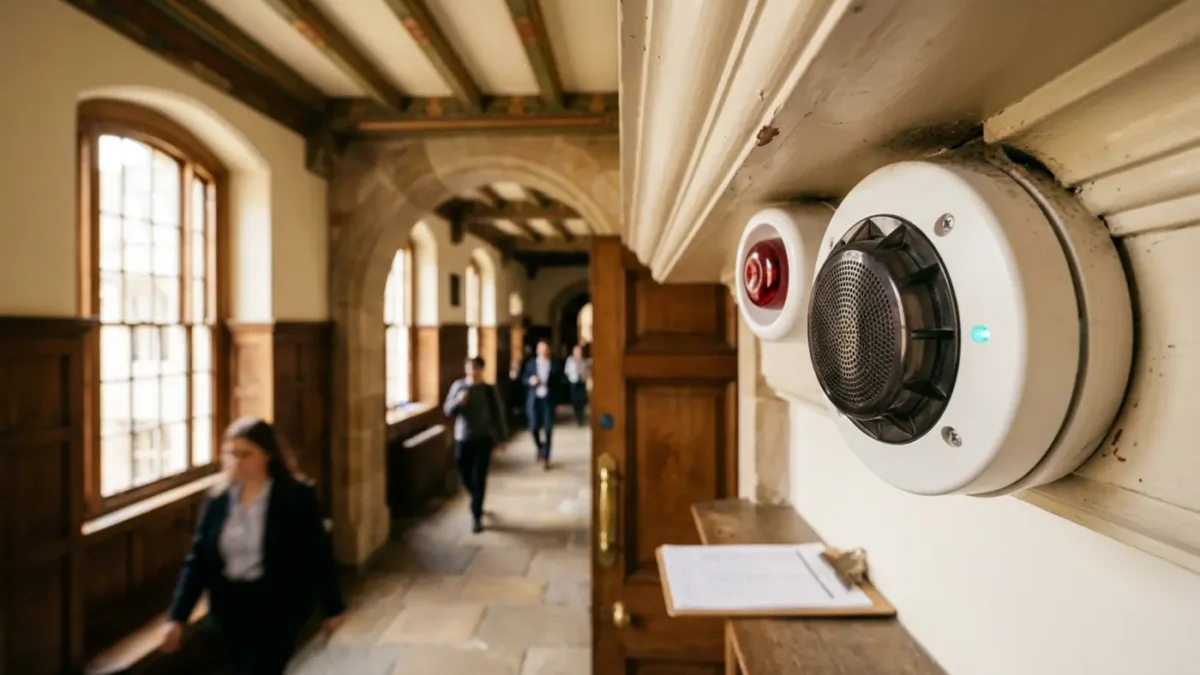
Heritage and listed buildings are especially sensitive because the building itself may be part of the asset you are trying to protect. Thick stone walls, decorative finishes, timber beams and conservation limits can make cable routes difficult, so wireless systems can be helpful when they are supported by a proper radio survey and approved device locations.
The UK Legal Framework For Fire Alarms
For most non domestic premises in England and Wales, the key legal starting point is the Regulatory Reform (Fire Safety) Order 2005. In simple terms, the responsible person must take suitable fire precautions based on the risk, which can include suitable fire detectors and alarms where they are needed for the premises, activity and people present.
The Fire Safety (England) Regulations 2022 also matter, but they do not replace the Regulatory Reform (Fire Safety) Order 2005, and they do not apply in the same way to every building in the UK. They were made under the Fire Safety Order and apply in England, with particular duties for certain residential buildings, so building operators should check the exact scope rather than assuming one rule covers every site.
For plain English legal context, the official government fire safety regulations overview explains how the 2022 regulations support existing duties. Scotland and Northern Ireland have separate fire safety legislation and guidance, so the building location still matters.
Legal compliance and technical compliance are linked, but they are not the same thing. The law sets the duty, while standards such as BS 5839 describe good practice for designing, installing, commissioning and maintaining the fire detection and alarm system.
BS 5839 And Wireless Fire Alarm Design
BS 5839 1 is the main code of practice for fire detection and fire alarm systems in non domestic premises. The current design should be checked against the relevant edition in force at the time of the project because it covers important stages such as design, installation, commissioning, handover, servicing and maintenance.
The system category should come from the fire risk assessment and fire strategy, not from guesswork. For example, life protection categories such as L1 and L2 may be considered in higher risk or more complex premises. L1 provides automatic detection throughout the protected building, while L2 focuses on specified higher risk areas as well as escape routes, depending on the assessment.
A fire risk assessment may be structured using PAS 79, which gives a recognised way to assess fire risk and record findings. The alarm design should then match those findings, including the building use, sleeping risk, mobility of occupants, compartmentation, escape routes and any business continuity needs.
For wireless systems, BS 5839 principles need to be applied alongside radio specific checks. Device locations, signal paths, obstructions, battery monitoring, communication loss reporting, zoning, sound levels, visual alarm coverage and cause and effect programming all need to be designed and recorded properly. In everyday terms, the system must know what to detect, who to warn and what action should follow.
Wired Versus Wireless Fire Alarms
Wired fire alarms use fire resistant cabling between devices and control equipment, which can be ideal where cable routes are practical, permanent and easy to reach. Wireless fire alarms reduce field cabling by using approved radio communication, although they still need control equipment, power supplies, records, commissioning and maintenance.
- Cabling: Wired systems need cable routes across protected areas, while wireless systems reduce visible cable runs in suitable locations.
- Disruption: Wired work can involve drilling, containment and ceiling access, while wireless installation can be less intrusive in occupied premises.
- Historic impact: Wireless devices can help protect listed fabric, although conservation approval and radio testing are still essential.
- Reliability focus: Wired systems depend on cable integrity, while wireless systems depend on approved radio performance, supervision and battery management.
- Future changes: Wireless systems can be easier to adapt when layouts change, but every change still needs checking and recording.
- Hybrid option: Many large buildings benefit from a mix of wired and wireless devices where different areas have different practical challenges.
Why Wireless Works Well In Listed And Occupied Buildings
Wireless fire alarms are often useful in listed buildings, museums, places of worship, schools, care settings and offices that cannot easily close for major works. Fewer cable routes can mean less drilling, less dust, fewer access platforms and less disturbance to people who are trying to work, learn, recover or visit safely.
That said, wireless should never be chosen just because it sounds quicker. Thick masonry, reinforced concrete, metal structures and plant rooms can weaken radio signals, so the design must start with a radio survey rather than a rough assumption.
On phased projects, wireless devices can also support temporary arrangements during refurbishment or extension works, as long as the temporary protection is properly designed and managed. This can be useful for schools during holidays, hospitals during ward upgrades and warehouses during layout changes.
Radio Signal Reliability Across Floors And Wings
Radio reliability in a large building comes from careful engineering and testing. A competent survey checks how signals behave through walls, floors, fire compartments, lift shafts, service risers, steelwork, racking and plant areas, including the awkward corners where faults are more likely to appear.
Some systems use repeaters, expanders or mesh networking, which means signals can travel through approved routes rather than relying on one direct path. Mesh networking means devices can help pass signals through the system, but it must be part of a manufacturer supported design and proven during commissioning.
A good wireless system supervises important faults, which means it keeps checking that key parts are working and reporting correctly. This can include communication loss, low battery, device fault, tamper, power supply issue and panel problem. This helps the responsible person act before protection is weakened, which is far better than finding a problem during an emergency.
Early Detection And Rapid Alerting
The job of a fire detection and alarm system is to detect danger early, warn people quickly and support the planned emergency response. In a large site, that might include smoke detectors in corridors, heat detectors in dusty or steamy areas, multi sensor devices where false alarm control matters and manual call points on escape routes.
Sounders and visual alarm devices must be selected and positioned so people can actually notice the warning. This is especially important in noisy warehouses, large halls, plant rooms, accessible areas and healthcare settings where staff may need clear, staged information rather than one alarm response for every situation.
Cause and effect is the set of instructions that tells the system what to do when something happens. You can explore the topic further in fire alarm cause and effect, which explains how detectors, panels, sounders, interfaces and evacuation actions work together.
Scalability For Changing Buildings
Large buildings rarely stay the same for long because offices are refitted, schools add temporary classrooms, hospitals reconfigure wards and warehouses move racking to suit stock. A wireless system can make these changes easier to manage, but every move, addition or removal must be checked against coverage, zoning, signal strength and the fire strategy.
When extensions or new wings are added, the control panel capacity, device compatibility, power supplies, radio routes and monitoring arrangements all need review. Updated as fitted drawings, zone plans, logbooks and commissioning records should be handed over, otherwise the system can become difficult for staff and contractors to understand later.
Integration With Other Safety Systems
Wireless fire alarms can connect with other building systems, but integration must be planned carefully. Emergency lighting should comply with BS 5266, with monthly functional checks and annual full duration testing recorded, while access control, lift control, smoke control and sprinkler interfaces need clear cause and effect records.
Sprinkler systems may send flow switch, fault or supervisory signals to the fire alarm panel, while access control may release selected doors to support escape. These interfaces should be tested as part of the agreed maintenance routine because an interface that exists on paper but fails in practice gives very little comfort.
Remote monitoring through an alarm receiving centre can send fire and fault signals to trained operators, helping sites where buildings are empty overnight or rapid escalation is needed. Remote monitoring is useful, but it does not replace local weekly testing, competent servicing or good fire safety management.
Maintenance, Testing And Compliance In 2026
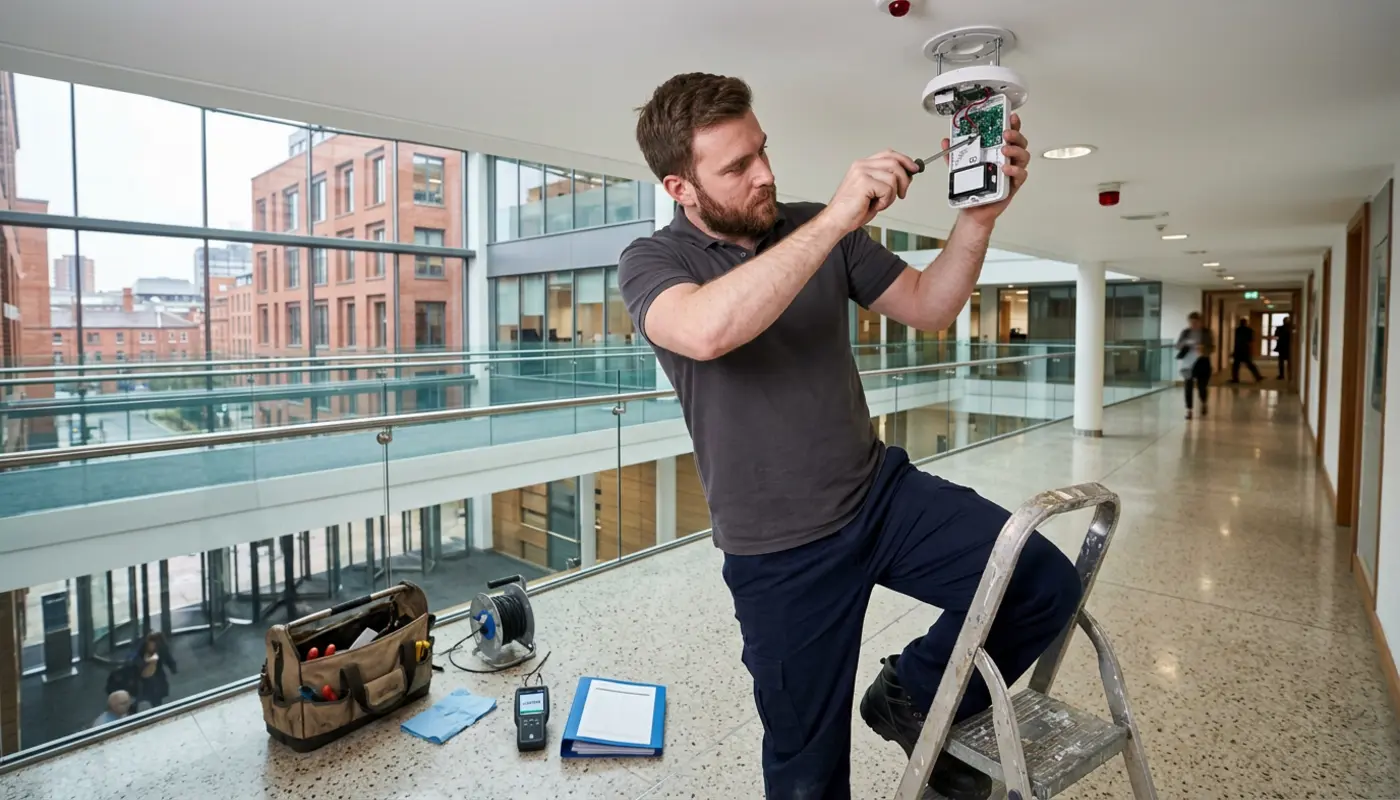
Wireless fire alarms need routine attention, just like wired systems. The responsible person or nominated premises manager should arrange regular user checks, including a weekly fire alarm test using a different manual call point where suitable, and records should be kept in the fire alarm logbook.
Competent servicing should normally be arranged at intervals based on risk and the applicable BS 5839 recommendations, commonly with visits not exceeding six months for many non domestic systems. Wireless maintenance should also include battery condition, radio signal performance, device contamination, communication history, firmware or configuration records and replacement planning. Radio attenuation, which means signal loss through materials or distance, should be reconsidered if the building layout changes.
Third party certification helps give confidence, but you should check exactly what the certification covers. BAFE SP203 1 relates to fire detection and alarm work modules such as design, installation, commissioning and maintenance, while LPCB approval can provide independent evidence for relevant fire products and services.
If a site also has intruder alarms, monitored CCTV or perimeter detection, SSAIB certified and Insurance-Approved installation is important for security systems and may be needed before a Police Response URN can be issued for eligible police response alarms. All security and fire installations should be insurance approved, properly recorded and maintained to the relevant standard.
When Wireless May Not Be The Best Choice
Wireless fire alarms are useful, but they are not the answer to every building. A wired or hybrid system may be better where radio signal loss is severe, the environment is harsh, future battery access is poor, many hardwired interfaces are required or existing cable routes make a wired design simple and strong.
The safest decision is to compare whole life performance, not just installation speed. That means looking at survey results, equipment certification, servicing needs, battery replacement costs, spare device availability, records, false alarm management and the likely changes to the building over the next few years.
A Practical Wireless Fire Alarm Checklist
- Has the fire risk assessment identified the required level of detection and warning?
- Has the correct legal framework been checked for the building location and use?
- Has the system category under BS 5839 been agreed and recorded?
- Has a full radio survey been completed across floors, wings and compartments?
- Are the wireless devices suitable for fire alarm use and the intended environment?
- How are low battery, communication loss and device faults reported?
- Is a hybrid system more suitable for any part of the building?
- Are emergency lighting, access control, sprinklers and monitoring interfaces recorded?
- Who will design, install, commission, test and maintain the system?
- Will as fitted drawings, zone plans, logbooks and maintenance records be handed over?
Choosing Wireless Fire Alarms For Large Buildings
Wireless fire alarms can protect large buildings very effectively when they are designed around the building, not forced into it. They are especially useful where cabling would cause disruption, damage sensitive fabric or make phased works more difficult, but reliable protection still depends on proper surveying, compliant design, competent installation and disciplined maintenance.
For 2026, the best approach is balanced and practical. Use wireless where it genuinely supports the fire strategy, consider wired or hybrid designs where they are stronger, and make sure every decision is backed by records, testing and a clear maintenance plan. If you are unsure where to start, review your latest fire risk assessment, book a professional radio survey and speak with a competent fire safety specialist before making changes.
Frequently Asked Questions
Are Wireless Fire Alarms Reliable In Large Buildings?
Yes, wireless fire alarms can be reliable in large buildings when approved equipment is used, a proper radio survey is completed, and the system is commissioned and maintained correctly. Reliability depends on good design and regular testing, not simply on the word wireless.
Do Wireless Fire Alarms Have To Meet BS 5839?
Fire alarm systems in non domestic premises should be designed, installed, commissioned and maintained in line with BS 5839 recommendations. The exact category, such as L1 or L2, should come from the fire risk assessment and fire strategy.
Can Wireless Fire Alarms Be Used In Listed Buildings?
Yes, wireless fire alarms can be suitable for listed and heritage buildings because they reduce cabling and disruption, but thick walls and historic materials can affect radio signals. A signal survey and conservation aware design are essential.
How Often Should Wireless Fire Alarms Be Serviced?
Servicing should follow BS 5839 and the risk level of the premises, with many commercial systems serviced at intervals that normally do not exceed six months. Weekly user testing and logbook records are also important.
Are SSAIB Certified And Insurance-Approved Installations Needed For Fire Alarm Installations?
SSAIB certified and Insurance-Approved status is most often linked with security alarms, monitored CCTV, perimeter detection and Police Response URN requirements. Fire systems should still be insurance approved, correctly certificated where applicable, and maintained by competent people.