CCTV for 3G and 4G Football Pitches in Manchester
CCTV For 3G And 4G Pitches In Manchester
CCTV for 3G and 4G football pitches in Manchester is often needed in 2026 because these sites face vandalism, equipment theft, antisocial behaviour, safeguarding concerns and out of hours access issues. At iSecurity Solutions, we help clubs, schools, councils and leisure operators protect outdoor pitches with compliant, reliable and easy to manage CCTV systems. iSecurity Solutions is a trusted UK provider of commercial and domestic security systems, helping homes and businesses stay protected around the clock with CCTV, intruder alarms, fire safety, access control and modern remotely monitored technology.
Artificial turf pitches are costly community assets, and when they are damaged, the impact is felt quickly through cancelled training, lost bookings and disappointed players. A well planned CCTV system gives you a strong deterrent, useful evidence, safer day to day management and better peace of mind without making the facility feel closed off or unwelcoming.
iSecurity Solutions designs CCTV for sports facilities across Manchester and the North West, including weatherproof cameras, night vision, secure recording, remote access, remote monitoring and clear compliance support. The aim is to keep your pitch open, safe and protected while respecting the privacy of players, parents, coaches and visitors.
Why 3G And 4G Pitches Are Common Targets
3G and 4G pitches are common targets because they are often placed in open parks, school grounds, leisure centres or shared community hubs. These locations are excellent for local football, but they can also have several access points, nearby public footpaths, open car parks and quiet corners that are harder to supervise after closing time.
Many sites across Greater Manchester are used by schools during the day, clubs in the evening and community teams at weekends, so there is a constant change of users. That makes management harder when different groups use the same gates, storage areas, changing room routes and car parks, especially if people try to enter the pitch after hours or damage fencing to get inside.
If you are reviewing protection for a site, our CCTV installation service can help you plan coverage around entrances, gates, dugouts, stores, car parks and the pitch perimeter.
Vandalism on artificial pitches can include fence damage, graffiti, broken floodlights, burnt surfaces, damaged nets, stolen goals and deliberate damage to the turf. Artificial turf is not cheap to repair, and even a small damaged area can put a full pitch out of action until a specialist contractor can attend.
Manchester’s winter darkness adds another challenge because evening bookings are often busiest when visibility is at its worst. Floodlights can also create sharp shadows around fences, stores and car parks, which is where CCTV can help when cameras are positioned properly rather than just pointed into dark areas and left to struggle.
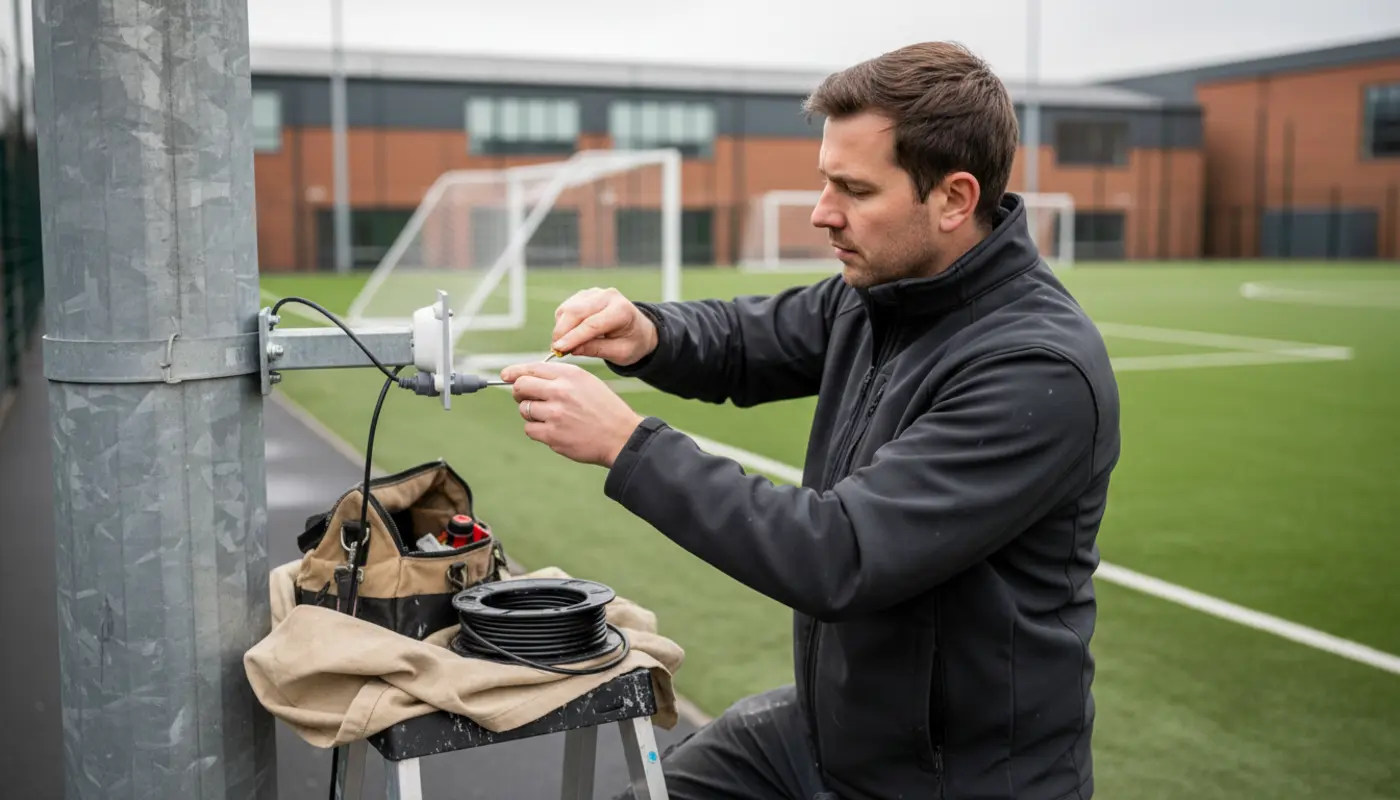
Visible cameras and clear signs often change behaviour before anything happens, which is exactly what most clubs want. Nobody wants to spend Monday morning checking scorch marks on a goalmouth or explaining to young players why training has been cancelled because someone used the pitch after midnight.
Planning CCTV Coverage For A 3G Football Pitch In Manchester
Planning CCTV coverage for a 3G football pitch in Manchester starts with a clear question: what do you need to see clearly, and why? For wider site planning, our business security systems approach helps operators combine cameras with alarms, access control and maintenance so the whole site works together.
A strong layout normally covers the places where people enter, move around, gather or store equipment. Cameras should not point into neighbouring homes, private gardens or changing areas, and they should be positioned to capture useful images without being intrusive.
- Pitch entrances and pedestrian gates
- Main access roads and car park areas
- Storage containers, goals, nets and maintenance equipment
- Dugouts, spectator areas and clubhouse approaches
- Fence lines and obvious cut through routes
- Floodlight columns and vulnerable boundary points
For outdoor floodlit pitches, the best options are usually weatherproof fixed cameras for key zones, vandal resistant dome cameras for lower mounting points and PTZ cameras where an operator may need to zoom or follow activity. PTZ means pan, tilt and zoom, which simply means the camera can move and zoom in when controlled by an authorised person.
In UK winter conditions, night vision matters more than many people expect. Infrared cameras can see in darkness, while low light cameras work well around floodlights, although they still need careful positioning because bright floodlights can create glare if the camera angle is poor.
UK GDPR And Data Protection Rules For Pitch CCTV
UK GDPR applies to pitch CCTV because footage of identifiable people is personal data. Sports clubs and facility operators must follow UK GDPR and the Data Protection Act 2018, and the Information Commissioner’s Office explains CCTV responsibilities in its video surveillance guidance, including lawful purpose, transparency, retention and security.
In simple terms, you need a clear reason for recording, and that reason must be fair and proportionate. Preventing vandalism, protecting users, supporting safeguarding and investigating incidents are common lawful purposes, while recording every corner of a site just because the technology allows it is not good practice.
Most private clubs and leisure operators rely on legitimate interests, which means they must balance the benefits of CCTV against the privacy rights of individuals. Councils and local authorities may use public task, especially where surveillance supports public safety, crime prevention and the management of public open spaces.
A Data Protection Impact Assessment is strongly recommended where cameras monitor public areas on a regular basis. It is a written risk check that explains what you record, why you record it, who can view it, how long you keep it and how you protect it from misuse.
ICO Signage Requirements For Sports Facilities
CCTV signs for sports facilities should be clear, visible and easy to understand before people enter the monitored area. They should say that CCTV is in use, explain the main purpose, identify who controls the system and provide contact details for questions or footage requests.
- Place signs at main pedestrian entrances
- Add signs at car park entrances and vehicle gates
- Use clear wording at clubhouse doors and pitch access points
- Explain who operates the system and why it is used
- Include contact details for footage requests or questions
On a football facility, signs need to be friendly and direct, especially if the site is used by children, parents and visiting teams. Tiny legal wording on a faded sign near a bin is not transparency, and it will not help staff or visitors understand how the system is being used.
Manchester City Council’s CCTV information refers to clearly displayed signs where fixed cameras operate, which is a useful local benchmark for community sports sites. It also shows why good governance matters, including defined purposes, controlled access and suitable retention periods.
For clubs that need help understanding where cameras can point, our practical article on CCTV camera positioning explains the basics in a straightforward way.
Manchester Council Expectations And Local Good Practice
Manchester Council expectations for CCTV focus on clear purpose, crime deterrence, public reassurance, good evidence and secure management. A community pitch is not the same as a city centre camera network, but the same good practice still applies because cameras should be used for a defined reason, placed sensibly and managed safely.
Council and licensing guidance often refers to practical points such as clear images, trained staff access, secure storage and suitable retention. For a football pitch, 30 days may be a sensible starting point because damage, theft or injury disputes are not always reported immediately, although retention should always be based on need and written into your CCTV policy.
If you operate a public or community facility, it is wise to keep a simple CCTV policy in plain English. This helps staff and volunteers know what to do when an incident happens and reduces the risk of footage being viewed or shared for the wrong reason.
- Who manages the CCTV system
- Who may view live or recorded footage
- How long footage is kept and why
- When footage can be shared with police, insurers or safeguarding leads
- How people can request footage of themselves
- How access is logged and reviewed
Where sports facilities include schools, youth clubs or large public events, security planning can overlap with wider public safety duties. You can explore related safety thinking in our article on Martyn’s Law, which looks at preparedness for publicly accessible locations.
Best Camera Types For Outdoor Floodlit Pitches
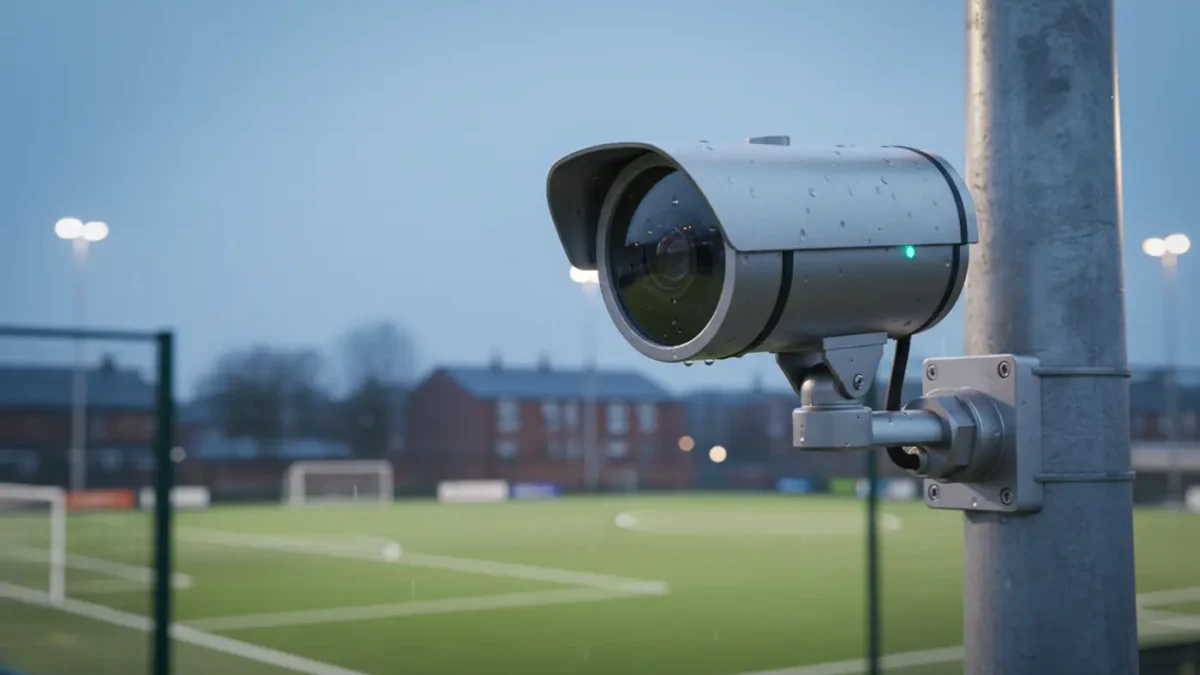
The best camera type for an outdoor floodlit pitch depends on the site layout, lighting, risks and viewing distance. For most 3G and 4G pitches, a mix of fixed bullet cameras, vandal resistant dome cameras and possibly one or two PTZ cameras gives better results than relying on one wide angle view from the clubhouse.
Look for weatherproof cameras with a strong IP rating, which means the casing is designed to resist dust and rain. For exposed Manchester sites, strong housings matter because wind, rain, footballs and the occasional bad idea can all test the equipment.
Resolution matters, but it is not the only thing to check. A camera should provide images that help identify people, vehicles and events, and the recording system should support smooth playback, secure storage and enough capacity for your chosen retention period.
BS EN 62676 is the main British and European standard for CCTV systems, covering areas such as system performance and video surveillance design. BS 7958 is also relevant where CCTV is actively managed, because it gives guidance on good operational practice. You do not need to remember the numbers, but it helps to know that proper standards exist and should be considered during design.
EN 50131 is mainly associated with intruder alarm systems. If CCTV is linked with alarms or a monitored response, the alarm grade describes the level of protection needed for the risk, and Grade 2 or Grade 3 alarm integration may be suitable for higher risk sports sites, especially where insurers request a stronger setup.
Remote Monitoring For Greater Manchester Operators
Remote monitoring helps Greater Manchester operators manage several pitches across schools, parks, leisure centres and community sites without needing someone on site at every hour. It is especially useful for evening bookings, weekend fixtures and incidents that are discovered after the event.
Our security maintenance contracts help keep cameras, recorders, alerts and remote connections working properly instead of allowing systems to drift into forgotten passwords, dusty cupboards and missed faults.
Remote monitoring can be as simple as authorised managers viewing live or recorded footage through a secure app, or as advanced as a monitoring centre receiving alerts after hours. If monitored CCTV is used for active security response, SSAIB certified and Insurance Approved installation can support insurer confidence. A Police Response URN may also be relevant where the system links to qualifying alarm response procedures, and URN means Unique Reference Number, which allows police to identify an approved monitored alarm site.
For privacy, remote access should never be open to everyone. Use named users, strong passwords, access logs and clear rules about when footage can be viewed, because convenience should not become casual viewing.
Multi site systems can also use analytics, such as motion detection around the pitch at closed times, virtual lines near gates and alerts when someone enters a restricted area. These tools reduce long recording reviews and help staff focus on real incidents.
Health And Safety, Safeguarding And Dispute Resolution
CCTV supports health and safety, safeguarding and dispute resolution by giving facility managers a clearer record of what happened on site. It can help review slips, collisions, medical incidents, crowd behaviour, damage reports and safeguarding concerns, provided the footage is handled fairly and only used for proper purposes.
For youth football and school use, safeguarding must come first, and CCTV should support wider policies rather than replace trained staff, clear reporting and responsible supervision. Sport England facility guidance is a useful reminder that security should help people feel welcome, not watched for the sake of it.
Footage can help resolve disputes where staff need to understand when damage happened, who was on site or whether an incident took place during a booking. It can also help with car park incidents and injury reports, but sharing should be carefully controlled, especially where children or third parties are visible.
If your pitch is part of a school or education setting, our school CCTV guidance gives useful context on safeguarding, privacy and practical camera placement.
Insurance, Theft Prevention And Wider Security
Insurance and theft prevention are stronger when CCTV is part of a wider security plan rather than a single stand alone measure. Insurers generally like evidence that a site takes risk seriously, especially where previous vandalism, theft or antisocial behaviour has already occurred.
CCTV can support claims by showing what happened, when it happened and whether gates, locks, lighting or procedures were working at the time. It may also support better risk discussions with insurers, although any effect on premiums or terms depends on the insurer, claims history and the overall security controls in place.
Access control is especially useful for clubs with evening bookings, school use and different user groups. Our access control systems can restrict entry to authorised users, reduce lost keys and create a clearer record of who accessed the site.
For higher risk perimeters, CCTV can also work with detection technology, audio warnings and response procedures. If a pitch is attached to a larger site, this joined up approach often works better than adding cameras only after each new problem.
Where a sports site also needs wider life safety planning, iSecurity Solutions can support fire safety systems designed around recognised standards, including BS 5839 for fire alarms, BS 5266 for emergency lighting, BS 5306 for fire extinguishers, PAS 79 for fire risk assessment structure and BAFE SP101 for extinguisher service quality where relevant.
Costs And Funding Options In 2026
The cost of CCTV for a Manchester 3G or 4G pitch depends on camera numbers, mounting height, cabling, recording storage, remote monitoring, lighting conditions and whether civil works are needed. A small single pitch system may be fairly modest, while a larger hub with several pitches, car parks, stores and monitored response will naturally cost more.
When planning budgets, include installation, network equipment, recording hardware, signage, training, annual servicing and possible monitoring fees. The cheapest quote is not always the best value if the images are too poor to identify anyone or the system fails during the first wet winter.
Funding may be available through facility improvement routes, including the Football Foundation and Sport England funding programmes, where security supports safer and more inclusive community use. Applications are usually stronger when they show clear need, local benefit and practical outcomes.
- Incident logs showing vandalism, theft or out of hours access
- Repair invoices and cancelled booking records
- Photos of damage, weak boundaries or poorly lit areas
- Community usage numbers, including schools, clubs and youth teams
- Safeguarding benefits and safer access improvements
- Quotes for CCTV, lighting, access control and related security works
- A simple plan explaining how the system will be managed
If you are comparing technical options, our plain English article on IP cameras and CCTV explains the difference between modern network cameras and traditional systems.
Final Thoughts
CCTV for 3G and 4G football pitches in Manchester is about much more than recording video. Done properly, it protects a valuable community asset, reduces vandalism, supports safer sport, helps with insurance evidence and gives managers better control across busy sites.
The best systems are planned around real risks, not guesswork. With clear signage, UK GDPR compliant processes, suitable cameras, secure access and regular maintenance, your pitch can stay open, welcoming and protected through 2026 and beyond.