How Much Does It Cost to Install Fire Alarm System
Fire Alarm System Cost
In the UK in 2026, the cost to install a fire alarm system can range from around £250 for a simple home setup to £30,000 or more for a large commercial or industrial site. The final price depends on the size of the property, the fire risk, the type of system, the amount of wiring, the level of detection needed and the British Standard category required.
If you are looking at fire alarm quotes and wondering why one price is much higher than another, you are not alone. Two buildings can look similar from the outside but need very different systems once you consider escape routes, kitchens, plant rooms, bedrooms, stores, high ceilings, shared areas and insurance needs.
iSecurity Solutions is a trusted UK provider of commercial and domestic security systems, helping homes and businesses stay protected around the clock. From CCTV and intruder alarms to fire safety, access control and construction site monitoring, the team designs reliable, tailored solutions backed by responsive service and modern, remotely monitored technology.
Average Fire Alarm Installation Costs In 2026
Average fire alarm installation costs in 2026 start at about £250 for basic domestic alarms and can rise above £30,000 for larger commercial systems. Domestic systems usually cost less because they need fewer devices, simpler controls and less complex certification than business, HMO or industrial fire alarm systems.
A basic domestic interlinked alarm setup may start from £250 to £500, while a more complete system covering key risk rooms and escape routes can reach £1,000 to £2,000 or more. Small business systems, such as those for shops, cafés and offices, commonly sit between £1,200 and £5,000 depending on the number of detectors, manual call points, sounders and zones.
Larger commercial premises, warehouses, schools, care settings and multi storey offices may range from £5,000 to £30,000 plus, especially where addressable equipment and wider coverage are needed. In simple terms, the more areas that need reliable detection and warning, the higher the installation cost will be.
- Basic Domestic Alarm System: Around £250 to £500
- Improved Domestic LD2 Or LD1 Coverage: Around £500 to £2,000 plus
- Small Shop Or Office: Around £1,200 to £3,500
- Small HMO: Around £1,500 to £5,000
- Medium Commercial Premises: Around £3,000 to £10,000
- Large Commercial Or Industrial Site: Around £8,000 to £30,000 plus
Fire Alarm System Types And Price Differences
The type of fire alarm system you choose has a direct effect on the final installation price. Some systems are simple and lower cost, while others give clear information about the exact device that has triggered, which is very useful in larger or higher risk buildings where a fast response matters.
Conventional Fire Alarm Systems
A conventional fire alarm system divides a building into zones, such as the ground floor, first floor or warehouse area. When the alarm activates, the panel shows the zone, but not the exact detector or call point, so someone still needs to check that area safely.
These systems are often cost effective for smaller shops, offices and simple commercial premises. Typical installed costs can start from around £1,200 and rise to £5,000 depending on the number of zones, detectors, call points, sounders and cable routes.
Addressable Fire Alarm Systems
An addressable fire alarm system identifies the exact detector, call point or device that has triggered the alarm. This makes it much easier to find a fire or fault, which is valuable in offices, schools, hotels, HMOs, care homes and industrial sites.
Addressable systems cost more because the panels, devices and commissioning process are more advanced. For medium sized buildings, costs often sit between £4,000 and £15,000, while larger sites can go beyond £30,000 when there are many rooms, risks and access areas to cover.
Wireless And Hybrid Fire Alarm Systems
Wireless fire alarm systems reduce the need for new cabling, which can save disruption in listed buildings, finished offices and occupied homes. They are not always the cheapest upfront, but they can be a sensible choice when running cables would mean lots of drilling, dust and repair work afterwards.
Hybrid systems use a mix of wired and wireless equipment. They are useful when most of the building can be wired neatly, but certain areas are harder to reach, such as extensions, outbuildings or heritage spaces where visible cabling would look out of place.
British Standards And Fire Alarm Grades
British Standards affect fire alarm cost because they set the expected level of design, coverage, installation, commissioning and maintenance. A system with wider coverage usually needs more devices, more wiring, more labour and more testing, so it will cost more than a basic system.
For non domestic premises, fire alarm systems should be designed, installed, commissioned and maintained in line with BS 5839 part 1. For homes and domestic premises, including many smaller rental properties, BS 5839 part 6 applies.
The main life safety categories under BS 5839 part 1 are L1, L2, L3, L4 and L5. L1 gives the widest life safety coverage, with automatic detection in all areas, while L2 focuses on defined higher risk areas and escape routes. L3 generally protects escape routes and rooms opening onto them, while L4 focuses mainly on escape routes and L5 is designed around a specific risk.
Property protection categories are P1 and P2. P1 provides automatic detection throughout the building, while P2 protects defined high risk or important areas. More coverage normally means a higher installation cost, but it can also reduce risk to people, property and business continuity.
Domestic grades run from Grade A to Grade F, with Grade A being a panel based system often used in larger or higher risk HMOs. Grade D systems are mains powered alarms with battery backup and interlinking, and they are commonly used in many domestic and rental settings.
Fire alarm work may also sit alongside other life safety systems. Emergency lighting is commonly designed and tested in line with BS 5266, while fire extinguishers are covered under BS 5306 and may be serviced by a BAFE SP101 registered provider. These are separate from the fire alarm itself, but they are often reviewed together during fire safety planning.
Key Cost Factors In Fire Alarm Installation
The main cost factors in fire alarm installation are property size, layout, risk level, system category, device count and cable access. A compact open plan shop may be simpler to protect than a smaller building split into many rooms, corridors, cupboards, kitchens and plant areas.
Every additional detector, manual call point, sounder, interface and beacon adds material cost and installation time. A basic office might need only a small number of devices, while a care home, HMO or warehouse may need detection in bedrooms, escape routes, communal areas, stores, plant rooms and higher risk spaces.
Cabling can also change the price significantly. Easy cable routes keep labour down, while solid walls, high ceilings, occupied premises, asbestos concerns, limited access and finished decorative areas can all increase the time needed on site.
If two quotes look completely different, professional fire safety systems support can help match the alarm category to the actual risk. This helps you avoid paying for unnecessary features, while also reducing the chance of under specifying the system and creating compliance problems later.
Labour And Installation Costs Across The UK
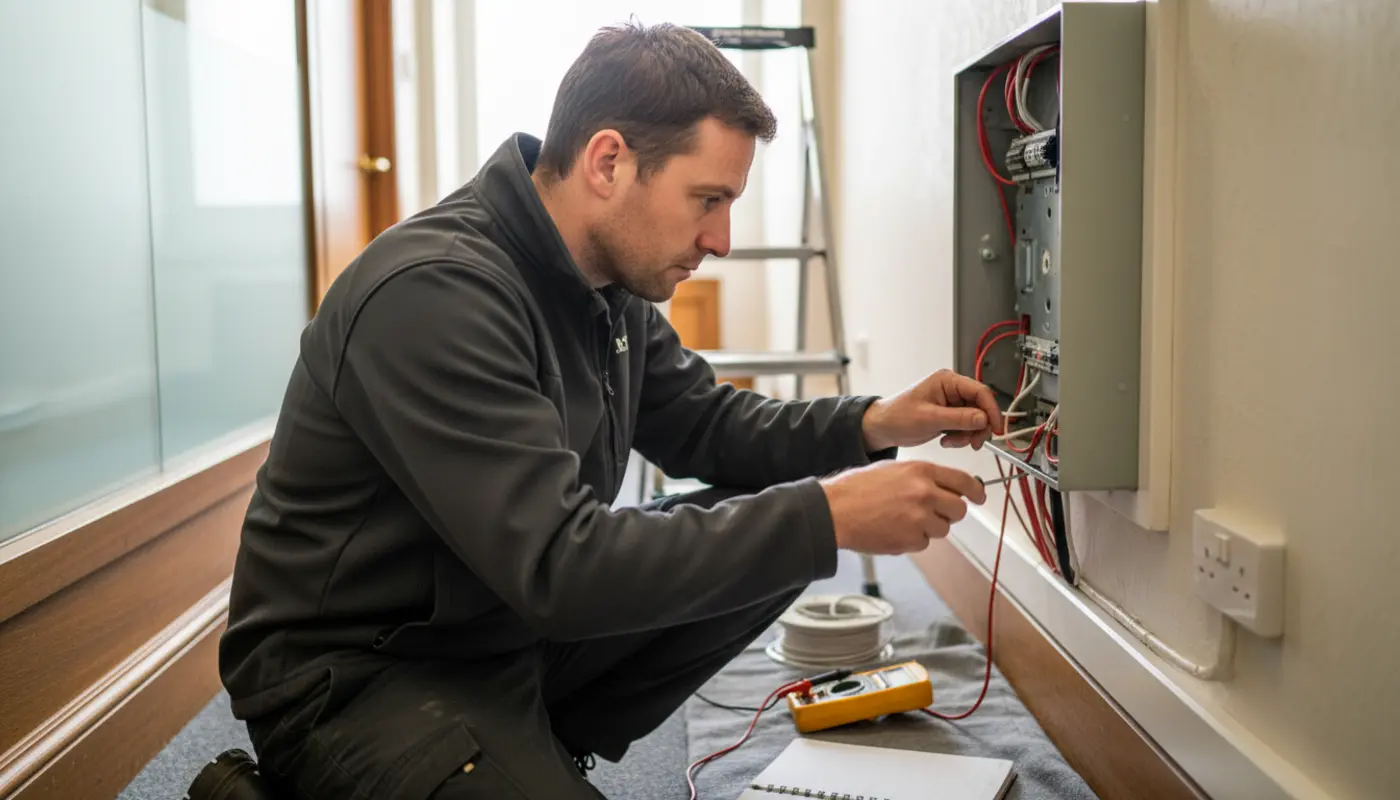
Labour costs for fire alarm installation vary across the UK because rates depend on the region, building access, project complexity and working hours. London and the South East often carry higher labour rates than many parts of the North of England, Scotland, Wales and Northern Ireland, sometimes by 20 to 30 per cent on comparable work.
Many installers price fire alarm work as a fixed project because it gives the customer a clearer total cost. Others may quote a day rate plus materials, especially where the building has unknown cable routes or the work involves changing an existing system.
Out of hours work can also add cost. If a shop, restaurant, school or office cannot close during the day, evening or weekend installation may be needed, which is helpful for business continuity but can increase the total budget.
Additional And Hidden Costs To Budget For
Additional fire alarm costs can include a fire risk assessment, design work, commissioning, certification, log books, call outs, monitoring, maintenance and making good after installation. These items are not always shown in the same way on every quote, so it is worth checking what is included before you compare prices.
A fire risk assessment is often the starting point for deciding what system is needed. Under the Regulatory Reform (Fire Safety) Order 2005 in England and Wales, the responsible person must make sure suitable fire precautions are in place, and that includes appropriate fire detection and warning where required.
Fire risk assessments should follow PAS 79 principles, which provide a recognised approach to reviewing fire hazards, people at risk and control measures. The findings can affect whether the building needs L1, L2, L3, P1 or P2 coverage, so the assessment can directly influence installation cost.
Other costs may include control panels, power supplies, backup batteries, interfaces with door holders, lift systems or smoke control, commissioning, certification and log books. In a compliant BS 5839 installation, proper testing and certification are not optional extras, even if a quote makes them look like one.
Making good should also be considered. Surface wiring, access holes, ceiling work and decoration touch ups may be minor on some jobs, but in smart offices, rental properties and customer facing shops, they can become a noticeable part of the overall budget.
Legal Requirements For Homes Landlords And Businesses
Legal requirements for fire alarms depend on the type of property, who uses it and the level of fire risk. Businesses, landlords and responsible persons must make sure the fire detection and warning system is suitable for the building and the people inside it.
For commercial premises, the responsible person must ensure fire safety arrangements are suitable for the building and the people using it. The law does not give one simple shopping list for every business, because a small office and a busy nightclub clearly do not carry the same risk.
In Scotland, duties sit under the Fire (Scotland) Act 2005 and related regulations, while Wales and Northern Ireland have their own enforcement arrangements. The practical message is similar across the UK: the system must be suitable, maintained and supported by proper records.
Landlords in England must follow smoke and carbon monoxide alarm rules, including smoke alarms on each storey used as living accommodation and carbon monoxide alarms in rooms with fixed combustion appliances. GOV.UK provides useful landlord guidance on the smoke and carbon monoxide alarm regulations.
HMOs are usually more demanding because several unrelated people live in the same property, often with shared kitchens and escape routes. Local authority licensing conditions may require Grade D LD2 systems for smaller HMOs and Grade A systems for larger or higher risk properties.
Ongoing Fire Alarm Costs After Installation
Ongoing fire alarm costs usually include planned servicing, user testing, battery replacement, repairs and, where needed, monitoring. A fire alarm is not a fit it and forget it item, even though everyone would prefer it to behave that way.
Commercial systems under BS 5839 part 1 are normally subject to weekly user testing and professional servicing around every six months. The weekly test is usually carried out by the building user and recorded in the fire log book, while the six monthly inspection is completed by a competent fire alarm engineer.
Small to medium premises may pay around £150 to £300 per service visit, with annual service contracts often ranging from about £250 to £500. Larger systems, multi site estates and buildings with complex addressable equipment can cost more, especially if parts, batteries or specialist access equipment are needed.
Monitoring is another possible ongoing cost. A monitored fire alarm can send signals to an alarm receiving centre, which is useful for higher risk sites, empty buildings or businesses where early response outside working hours matters.
You can explore what is commonly included in a maintenance package in fire alarm service contract details, especially if you want predictable costs instead of surprise call out fees.
Choosing An Installer And Saving Money Safely
Choosing the right fire alarm installer helps you control cost without cutting corners on safety or compliance. A good installer should ask about the building use, occupancy, fire risk assessment, existing systems, escape routes and insurance requirements before giving a proper quote.
If someone prices everything in two minutes without seeing drawings or visiting the site, that is not confidence, it is guesswork in a hi vis jacket. A proper quote should explain the proposed system type, BS 5839 category, device count, cable routes, commissioning, certification and maintenance options.
For non domestic fire alarm work, look for clear competence around BS 5839 part 1 and, where appropriate, BAFE SP203 part 1. FIA membership and NSI certification can also help demonstrate professional standards, but the quote should still clearly state what is included and what is not.
Where fire safety is part of a wider security package, it is also worth checking related accreditations. For intruder alarms, EN 50131 grades such as Grade 2 or Grade 3 may apply, and an SSAIB certified and Insurance Approved installer can help with insurer confidence and Police Response URN requirements where relevant. For networked security systems, structured cabling quality may be supported by BICSI knowledge and Fluke testing certification.
To compare quotes fairly, check the number of detectors, call points, sounders and interfaces included. Also check whether certification, user training, log books, warranties, maintenance visits and making good are included or charged separately.
If you are unsure whether your property needs Grade A or Grade D coverage, you can save money by agreeing the right category from the start, using wireless equipment only where it genuinely reduces disruption, and phasing work sensibly where the fire risk assessment allows it. Cutting out essential detection to save a few pounds is not really a saving, because it can create a larger risk later.
For certain public venues and premises with larger visitor numbers, Martyn's Law, also known as the Protect Duty, may influence wider safety planning. It is not a replacement for fire safety law, but it does encourage businesses and venues to think more carefully about emergency planning, communication and protective systems.
Final Thoughts On Fire Alarm Installation Costs
Fire alarm installation costs in 2026 usually range from a few hundred pounds for a typical home to several thousand pounds for a business, with large commercial sites often reaching £30,000 plus. The safest way to budget is to start with the required standard, system category and fire risk, then compare like for like quotes from competent installers.
A well designed fire alarm system is not just a box on the wall. It is part of the building's life safety plan, and when it is installed and maintained properly, it quietly protects people, property and peace of mind every day.