Best Fire Extinguisher for Garage Workshops in North West
Garage Fire Extinguishers North West
What is the best fire extinguisher for a garage workshop in the North West, and how do you make sure it meets BS 5306 and UK legal requirements?
If you run a motor trade workshop or spend weekends restoring cars in your home garage, fire safety can easily slip down the priority list. Many garage owners are unsure whether they have chosen the right extinguisher. With petrol, oils, LPG, battery chargers and welding equipment all stored in one place, garages are classed as higher risk environments and need the correct protection.
At iSecurity Solutions fire safety services, we support garage owners across the North West with compliant extinguisher supply, annual servicing under BS 5306, and practical fire protection plans that meet insurer expectations.
UK Legal Requirements And BS EN 3 Standards
All portable extinguishers supplied for UK workshops must comply with BS EN 3. This standard covers how extinguishers are designed, tested and rated for different classes of fire. You can read an overview on the BSI website, which explains how performance ratings are measured.
Motor trade premises must also follow the Regulatory Reform Fire Safety Order 2005. In simple terms, this means carrying out a fire risk assessment and providing suitable extinguishers selected and positioned in line with BS 5306. Insurers usually expect compliance with BS 5306 and servicing by a company certificated to BAFE SP101. Under BS 5306 3 extinguishers require annual servicing and a valid service certificate must be kept on site. Selection and siting rules are covered by BS 5306 8, including travel distances and mounting heights.
Fire Classes In Garage Workshops
Garage workshops are very different from offices. You are dealing with flammable liquids, pressurised gases, vehicle electrics and sometimes lithium batteries. This combination means you cannot simply buy the cheapest extinguisher and assume it will be suitable.
The most common fire classes in garages are Class B, Class C and electrical fires. Class B covers flammable liquids such as petrol, diesel and oils. Class C relates to flammable gases including LPG. Electrical fires involve live equipment such as battery chargers, compressors and diagnostic tools. Many garages also have Class A risks, including wooden benches, shelving and packaging materials. A proper fire risk assessment will confirm exactly what protection is required.
CO2 Vs Dry Powder Vs Foam For Garage Workshops
Choosing between CO2, dry powder and foam can feel confusing at first. Each type has clear advantages, but also limitations, especially when used indoors.
- CO2 is ideal for live electrical equipment and leaves no residue.
- Dry powder covers multiple fire classes but creates heavy dust.
- Foam works well on liquid fires and is easier to manage inside buildings.
CO2 Extinguishers
CO2 extinguishers are suitable for live electrical risks because they are non conductive and do not leave residue behind. They are commonly positioned near fuse boards, diagnostic areas and vehicle electrical workstations. UK guidance recommends at least a 2 kg CO2 extinguisher wherever electrical equipment is present.
However, CO2 has a short discharge time and is less effective on deep seated Class A fires. In small enclosed garages, ventilation must also be considered during use.
ABC Dry Powder Extinguishers
ABC powder extinguishers are often seen as a flexible option because they cover Class A, B, C and electrical fires. In larger commercial workshops across the North West motor trade, powder can provide wide ranging protection.
The drawback is the thick dust cloud created when discharged. This can reduce visibility and contaminate engines, tools and paintwork. In small home garages, the clean up and potential damage can sometimes outweigh the benefits.
Foam Extinguishers
Foam extinguishers are highly effective on Class A and Class B fires, making them well suited to petrol and oil risks. They are generally cleaner than powder and easier to control indoors.
For many garage workshops, combining foam for liquid and solid materials with CO2 for electrical equipment offers a balanced and insurer friendly solution.
BS 5306 8 Siting And Mounting Rules
BS 5306 8 explains how extinguishers should be positioned. For Class A risks, you should not normally travel more than 30 metres to reach a suitable extinguisher. For higher risk Class B areas, travel distance is usually limited to around 10 metres.
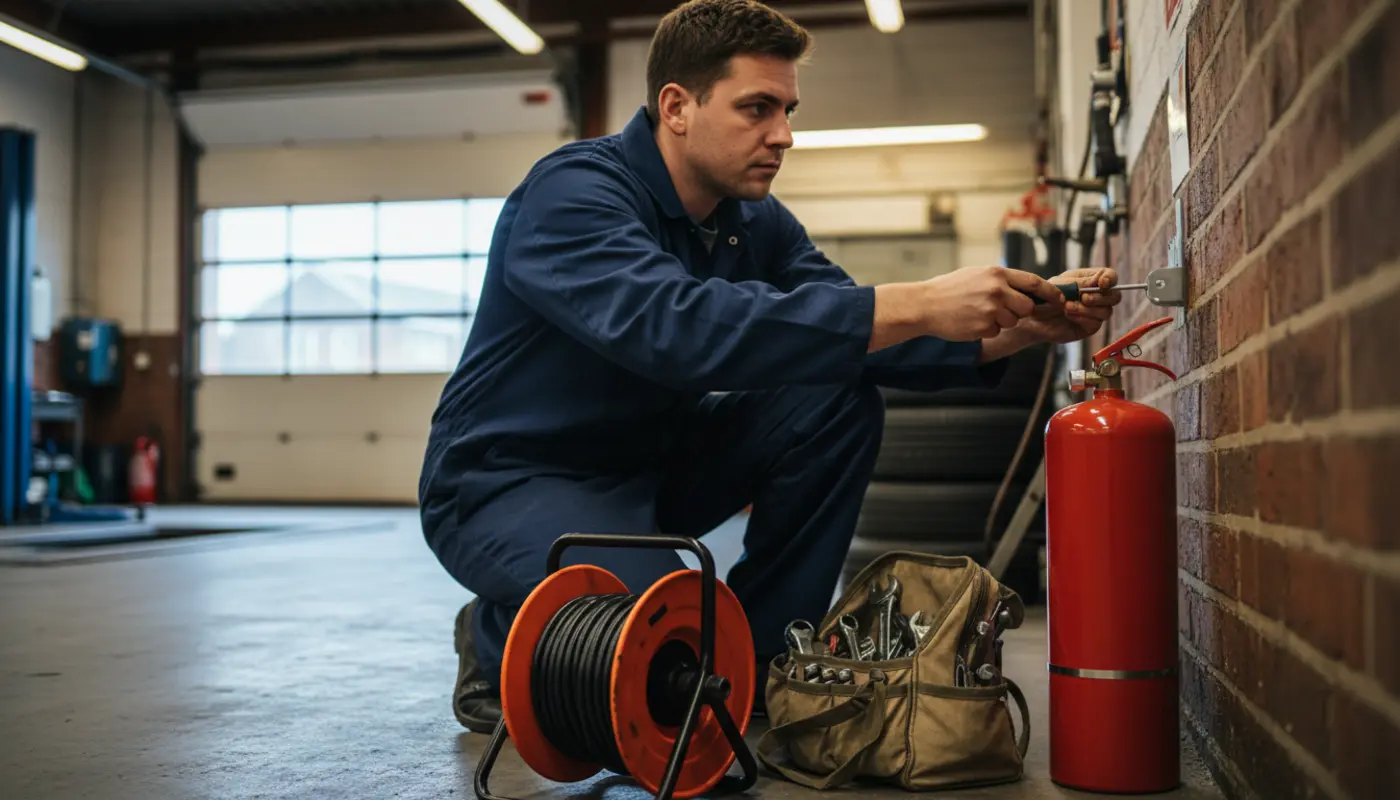
Extinguishers should be placed along escape routes and near exits, not hidden behind equipment or stored under benches. Mounting height is also important. Units up to 4 kg should have the handle no higher than 1.5 metres from floor level, while heavier units should be mounted lower. The base should sit at least 10 cm above the floor to reduce corrosion.
How Many Extinguishers Does Your Workshop Need
BS 5306 8 2023 provides minimum recommendations based on floor area. Premises up to 50 square metres require at least one extinguisher with a minimum 26A rating. From 50 to 400 square metres, at least two 26A rated extinguishers are required, with extra units added for larger spaces.
For example, a 40 square metre home garage may need one 6 litre foam extinguisher rated 21A or 27A, plus a 2 kg CO2 for electrics. A 150 square metre commercial workshop with several bays would normally require at least two higher rated foam units positioned correctly to meet travel distances, along with CO2 units at key electrical points. These figures are minimums, and a fire risk assessment may identify the need for additional protection.
BAFE Registered Suppliers In The North West
When purchasing extinguishers for motor trade use, always check that the supplier and servicing provider are certificated to BAFE SP101. This scheme confirms that technicians are competent to install and maintain extinguishers in line with BS 5306.
You can search the BAFE Fire Safety Register by postcode to find approved companies in the North West. Using a third party certificated provider offers reassurance to insurers and demonstrates that you are meeting your legal duties.
Many garage owners also combine extinguishers with additional protection such as intruder alarm systems that comply with EN 50131 Grade 2 or Grade 3. Where monitoring is required, installation must be by an SSAIB certificated company for Insurance Approved status and eligibility for a Police Response URN.
Annual Servicing Under BS 5306 3
Under BS 5306 3, extinguishers must be visually checked each month by the responsible person and serviced annually by a competent technician. Extended servicing is typically required every five years for foam and powder units, and every ten years for CO2.
Service records must be retained, and a valid annual certificate should be available for inspection. Most motor trade insurers in the North West will request this documentation following a claim. Ongoing support through structured security and fire maintenance contracts helps ensure compliance is maintained.
If you would like more detail on inspection and documentation, see fire extinguisher servicing legal requirements.
Fire Risk Assessment Obligations
For commercial workshops, a fire risk assessment is a legal requirement and should follow recognised guidance such as PAS 79. It must identify hazards, people at risk and the suitability of current controls, including extinguishers, detection systems and escape routes.
Although home garage owners are not usually covered by the same legislation, carrying out a simple written assessment is still good practice. It helps you consider fuel storage, electric vehicle charging and general housekeeping, all of which reduce risk.
Pairing Extinguishers With Blankets And Detection
Extinguishers are most effective when part of a wider fire protection setup. In garages where welding or grinding takes place, a fire blanket positioned nearby can quickly smother small fires involving clothing or work surfaces.
Early detection is just as important. Heat detectors are often better suited than standard smoke alarms in dusty workshop settings. Where a full fire alarm system is installed, it should comply with BS 5839, often Category L2 for higher risk commercial garages, and installations should be Insurance Approved.
After Use Recharging And Disposal
Any extinguisher that has been used, even briefly, must be recharged or replaced straight away. The discharge should be recorded in your fire safety log in line with BS 5306 3.
Old or discharged extinguishers are classed as hazardous waste and must not be disposed of in general rubbish. They should be returned to a competent provider or taken to an authorised recycling facility in accordance with local authority guidance.
Final Thoughts
Selecting the best fire extinguisher for a garage workshop in the North West is about matching the correct type and rating to your real risks. Compliance with BS 5306 8 for siting and BS 5306 3 for servicing ensures that protection is not only present, but also legally and professionally maintained.
Whether you operate a busy commercial workshop or maintain a well equipped home garage, getting this right protects your people, your vehicles and your livelihood. The standards can seem detailed at first, but with clear guidance they become straightforward and manageable.