How to Make a Fire Extinguisher for School Project in Manchester?
If your teacher has asked you how to make a fire extinguisher for school project in Manchester, you might feel excited and a little unsure about where to start. That is completely normal. Fire safety sounds serious because it is, but once you understand the basic science, it becomes much easier to manage.
Fire safety is an important topic in UK schools. Projects like this are designed to help you understand how fire works and how it is controlled. They are not about building a real extinguisher for emergencies. That difference is very important.
At iSecurity Solutions, we regularly support Manchester schools with compliant fire safety systems and compliance, including extinguishers that meet BS 5306 annual servicing requirements for DfE and academy trust insurance. In this guide, I will explain the history, the science, the standards, and how to create a safe classroom model that supports learning without putting anyone at risk.
How To Make A Fire Extinguisher For School Project In Manchester
Before building your model, it helps to understand where fire extinguishers came from and why they matter today. Britain played a key role in developing the first portable extinguisher. In 1818, Captain George William Manby patented an early design that used compressed air to push out a fire suppressing liquid. It was simple compared to modern equipment, but it changed firefighting forever.
As cities such as Manchester grew during the Industrial Revolution, the risk of large fires increased. This led to better firefighting tools and eventually to the portable extinguishers we recognise today. Over time, British Standards were introduced to make sure equipment used in public buildings, including schools, is safe and reliable.
Modern extinguishers in the UK must comply with BS EN 3, which sets rules for design, pressure testing, labelling, and colour coding. In schools, ongoing maintenance must follow BS 5306. Annual servicing certificates are required for insurance purposes and to meet DfE guidance.
How Fire Extinguishers Work And The Science Behind Them
To create a strong project, you need to understand the science. Fire needs three things to burn. These are heat, fuel, and oxygen. This is known as the fire triangle. If you remove one of these elements, the fire goes out. The Health and Safety Executive explains fire safety basics clearly, including how combustion works and why risk assessments are important in schools and workplaces.
Different extinguishers remove different parts of the fire triangle. Water cools the fire and removes heat. Foam smothers flames and reduces oxygen. Carbon dioxide pushes oxygen away from the fire. Powder interrupts the chemical reaction that keeps the fire burning.
If you would like to understand how alarms work alongside extinguishers, you may find our guide on how a fire alarm system works helpful. In real schools, extinguishers and alarms form part of one complete protection system.
UK Fire Classification System Explained
In the UK, fires are divided into classes. Showing that you understand these classes will make your school project stronger.
Class A involves solid materials such as wood and paper, which are common in classrooms. Class B covers flammable liquids like petrol. Class C relates to gases. Class D involves metals. Class F covers cooking oils, usually found in school kitchens. Electrical fires do not have a letter, but they are still clearly recognised as a risk.
Each class requires the correct type of extinguisher. Using the wrong one can make a fire worse. This is why training and clear signage are essential in schools.
Extinguisher Types And British Colour Codes
Under BS EN 3, all portable extinguishers in the UK must have a red body with a coloured band to show the contents. Water uses a red label, foam uses cream, dry powder uses blue, carbon dioxide uses black, and wet chemical uses yellow. The colour coding helps staff quickly identify the correct extinguisher in an emergency.
In Manchester schools, correct placement and signage are just as important as the extinguisher itself. If you are interested in how wider safeguarding measures support pupil safety, our article on CCTV for primary schools in Manchester explains how layered protection works in education settings.
Making A Simple Baking Soda And Vinegar Model Extinguisher
Now let us look at the practical side. This is only a science demonstration model. It is not a real fire safety device and must only be carried out with teacher supervision as part of an approved school risk assessment.
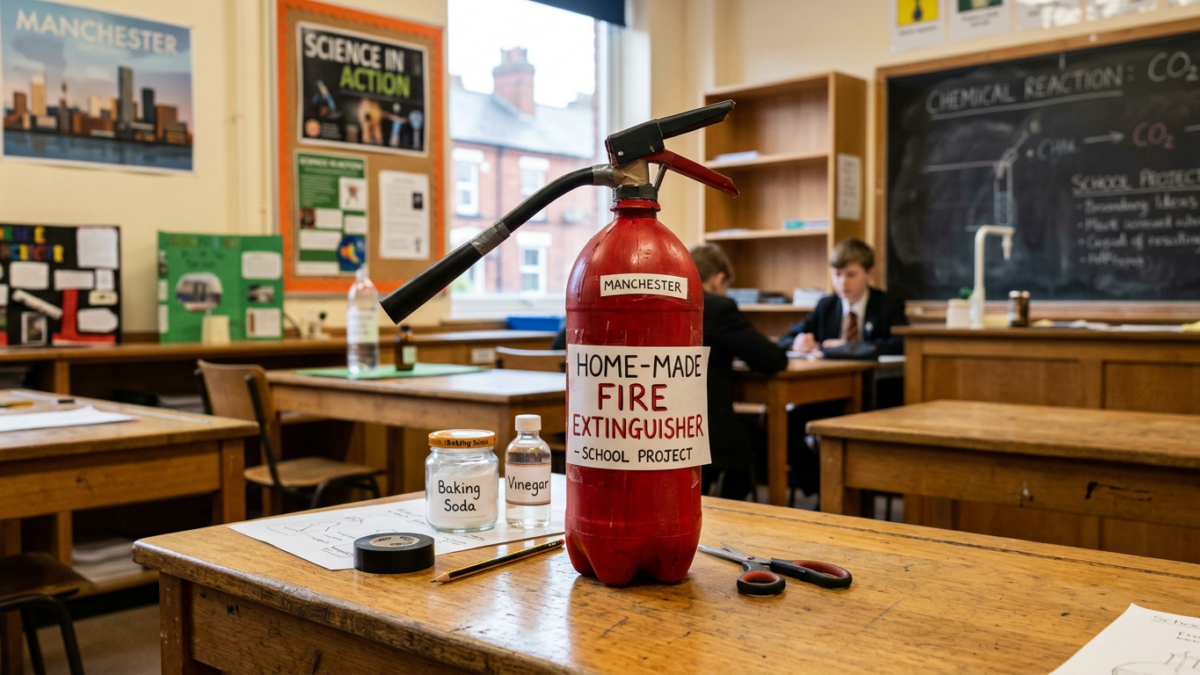
You will need a small plastic bottle, baking soda, vinegar, a balloon, and a tray to catch any overflow. Pour vinegar into the bottle. Place baking soda inside the balloon. Carefully fit the balloon over the bottle opening without tipping the powder in yet. When ready, lift the balloon so the baking soda drops into the vinegar.
The reaction produces carbon dioxide gas, which inflates the balloon. In a real carbon dioxide extinguisher, compressed CO2 is released to displace oxygen around the fire. Your model safely demonstrates the same principle without using flames. For guidance on how schools manage risk assessments, refer to GOV.UK school health and safety responsibilities, which explain how activities must be planned and supervised properly.
Demonstrating Your Project Safely In A Manchester School
Schools in Manchester follow national regulations as well as local authority policies. According to GOV.UK fire safety guidance for school buildings, fire risk assessments must be in place and regularly reviewed. Even a simple classroom demonstration should be approved in advance.
Greater Manchester Fire and Rescue Service provides education sessions and learning resources for schools. Referring to local fire safety education in your presentation shows strong awareness of community safety.
In real school environments, extinguishers are only one part of a complete fire protection system. Buildings rely on alarms designed to BS 5839, often Category L1 or L2 depending on the layout. Emergency lighting is installed to BS 5266, with monthly checks and annual full duration tests. Fire risk assessments are carried out in line with PAS 79. For a practical overview, see our guide to fire risk assessments in Manchester, which explains how structured assessments reduce risk in schools and commercial buildings.
School Fire Extinguisher Requirements In Manchester
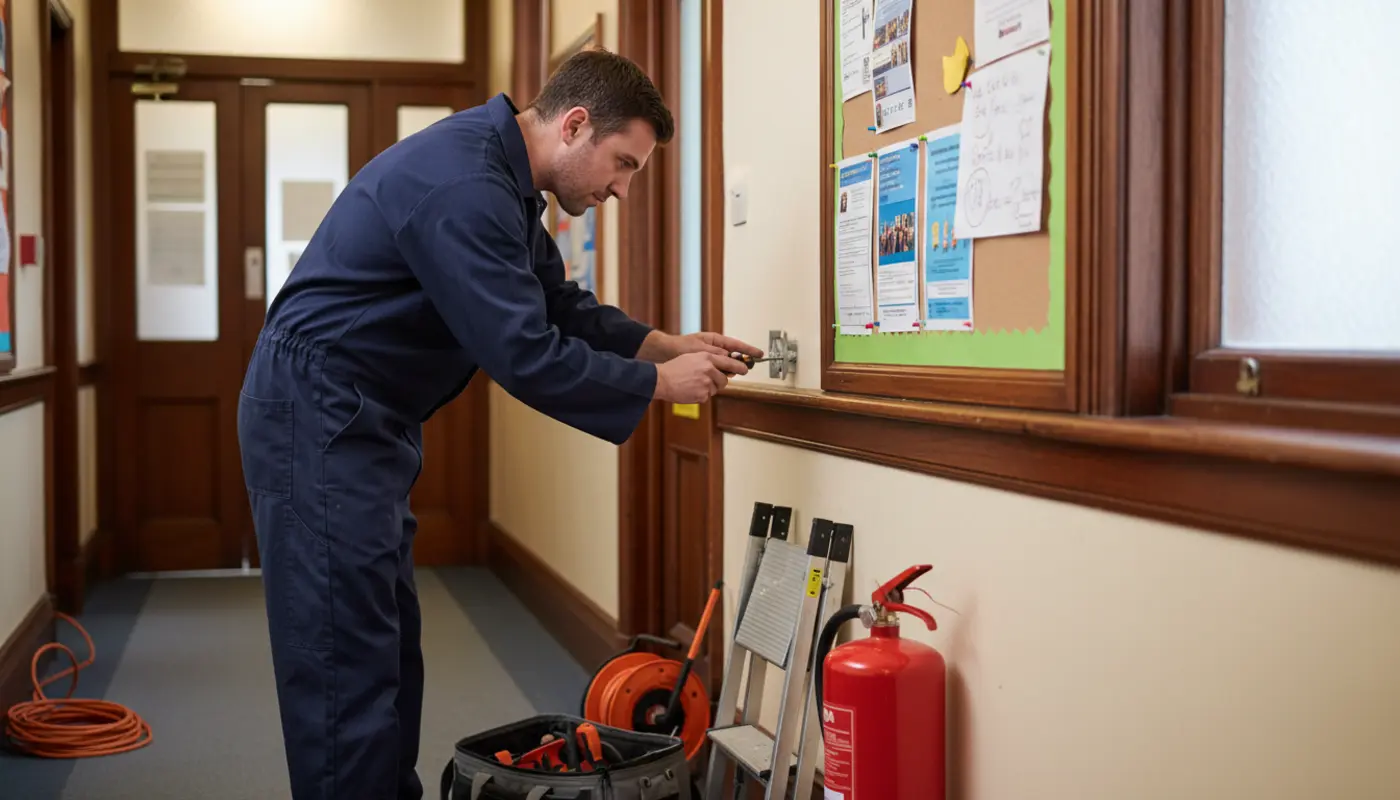
While your project is only a model, real extinguishers in Manchester schools must be professionally supplied and serviced. Under BS 5306, extinguishers require annual maintenance by a competent person. Schools must keep service records and certificates for insurance inspections and DfE compliance.
At iSecurity Solutions, we provide fire extinguisher servicing in Manchester that aligns with insurance requirements and recognised best practice. For organisations that need full protection, our security and fire system maintenance contracts show how ongoing compliance works across different sectors.
All fire and security installations we deliver are SSAIB certified and Insurance Approved, giving schools and organisations confidence that systems meet recognised industry standards. While extinguishers follow product and servicing standards such as BS 5306 and BAFE SP101 for providers, integrated alarm systems must meet additional certification and compliance requirements.
Careers In Fire Safety Engineering And Education
If this project sparks your interest, there are real career opportunities in fire safety engineering and compliance. Apprenticeships in fire and security systems, NEBOSH fire safety qualifications, and engineering degrees can all lead into this field.
Fire safety professionals design alarm systems to BS 5839, plan emergency lighting to BS 5266, carry out assessments under PAS 79, and ensure extinguisher servicing meets BS 5306 and BAFE SP101 requirements. It is a career that combines science, responsibility, and public protection. It plays a vital role in keeping Manchester schools and communities safe.
Final Thoughts
Learning how to make a fire extinguisher for school project in Manchester is a great way to explore science, history, and public safety in one activity. The most important thing is to understand how extinguishers work, why British Standards matter, and how schools manage risk properly.
Remember that real extinguishers must meet BS EN 3 manufacturing standards and receive annual servicing under BS 5306. Your classroom model is only there to demonstrate scientific principles safely. It must never replace certified life saving equipment.
If your school needs guidance on compliant fire protection, from extinguishers to alarms and emergency lighting, iSecurity Solutions is a trusted UK provider of commercial and domestic security systems. We help homes and businesses stay protected around the clock. From CCTV and intruder alarms to fire safety, access control and construction site monitoring, our expert team designs reliable, tailored solutions backed by responsive service and modern, remotely monitored technology. Whether securing a single school building or managing multi site estates, we deliver the equipment, expertise and peace of mind to keep what matters most safe.