Fire Risk Assessment for Businesses in Manchester

Fire Risk Assessment For Businesses In Manchester
Fire risk assessment. Manchester business. Legal requirement. Yes, it is a mouthful. But if you run a business in Manchester and it is not a private home, you need a fire risk assessment. Not optional. Not when you get around to it. Required.
This comes from the Regulatory Reform Fire Safety Order 2005. It puts responsibility on you, the business owner, landlord, or managing agent. No passing the buck.
At iSecurity Solutions fire risk assessment services, we help Manchester businesses cut the confusion, meet PAS 79 guidance, and understand their real risks. Not just tick a box and hope for the best.
What UK Law Says About Fire Risk Assessments
Let’s be real. The Regulatory Reform Fire Safety Order 2005 has been around for years. This is not new. Since 2006, it has required a suitable and sufficient fire risk assessment for all non domestic premises in England and Wales.
Article 9 is clear. The responsible person must carry out a fire risk assessment and keep it up to date. If you want the full wording, it is publicly available, including an overview on the Regulatory Reform Fire Safety Order 2005 page. But here is what actually matters.
If you control business premises, you are responsible for:
- Identifying fire hazards
- Identifying people at risk
- Evaluating and reducing risk
- Recording significant findings
- Reviewing regularly
A proper assessment should follow PAS 79 methodology. That means a structured written report. Not scribbles on the back of an envelope.
Which Manchester Businesses Legally Need A Fire Risk Assessment
Short answer. Almost all of them.
If you run an office in Spinningfields, a warehouse in Trafford Park, a shop in the Arndale, a restaurant in the Northern Quarter, or a small unit on an industrial estate, you need one.
The law covers:
- Offices and call centres
- Retail shops and salons
- Warehouses and factories
- Hotels and HMOs
- Schools and nurseries
- Healthcare premises
The only clear exclusion is a single private dwelling. Everything else is included. Stop pretending your small team of three makes you exempt. It does not.
The Role Of Greater Manchester Fire And Rescue Service
Greater Manchester Fire and Rescue Service enforces the Fire Safety Order locally. They inspect business premises. They issue alteration notices, enforcement notices, and prohibition notices.
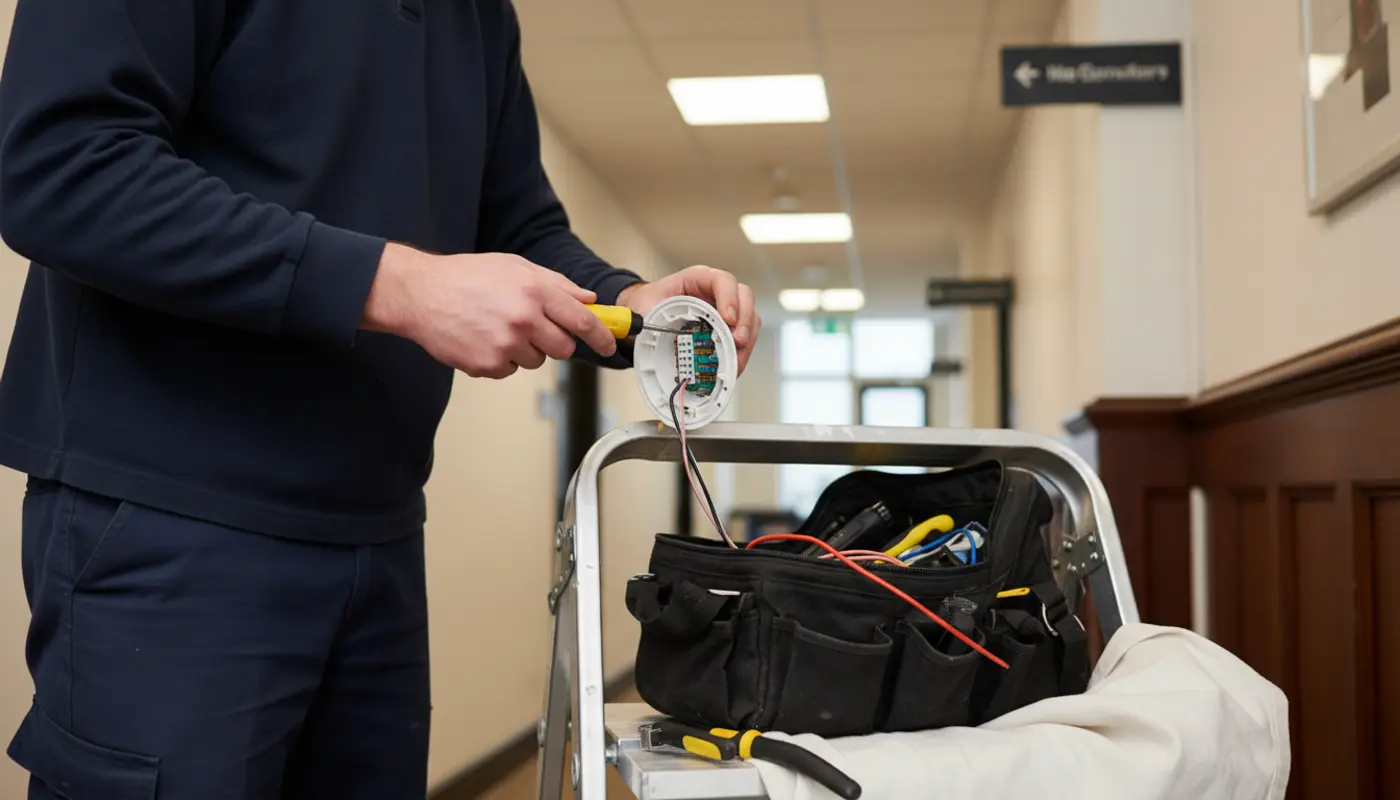
Here is what is actually happening. If they visit and your paperwork is weak, out of date, or copied from Google, they will not be impressed.
GMFRS provides guidance for local businesses on their website, including inspection expectations and sector advice. The enforcement framework is outlined by the government on gov.uk fire safety enforcement guidance. The powers are real. So are the penalties.
If your assessment highlights issues with alarms, you will need compliant systems installed to BS 5839 fire alarm standards, often Category L1 or L2 in higher risk premises.
Key Elements Of A Fire Risk Assessment For Manchester Business Premises
Cut the nonsense. A fire risk assessment is not just a checklist. It is a practical review of how a fire could start, who it could harm, and how you can prevent it.
Yes, there are standards and codes. No, you do not get to ignore them.
A proper PAS 79 aligned assessment should include:
- Sources of ignition
- Fuel and combustibles
- People at risk
- Escape routes and exits
- Fire detection and warning systems
- Fire fighting equipment
- Emergency lighting systems
Your fire alarm should comply with BS 5839. Your emergency lighting must meet BS 5266, with monthly flick tests and annual full duration tests recorded. Your extinguishers must be serviced to BS 5306 and BAFE SP101, with an annual service certificate that insurers expect.
If you do not know whether your systems meet these standards, that is exactly why you need competent support. Our emergency lighting services and extinguisher maintenance team make sure compliance is not guesswork.
Fire Safety Responsibilities For Manchester Landlords And Commercial Property Owners
Landlords, this is for you.
If you own a commercial building with multiple tenants, you are usually responsible for common areas. That includes corridors, stairwells, plant rooms, and shared escape routes.
Stop assuming the tenant will sort it. If a fire starts in a shared electrical cupboard, you will be answering questions.
You must ensure:
- Common escape routes are clear
- Fire doors are maintained
- Emergency lighting works
- Alarm systems are serviced
- A current fire risk assessment exists
If you also provide security systems, make sure cabling is professionally installed. Our BICSI and Fluke Certified network cabling includes as built drawings and test certificates at handover. It keeps safety and compliance tidy.
Common Fire Hazards In Manchester Offices Warehouses And Retail Units
Risks vary by sector. But some problems keep showing up.
In offices, we see overloaded extension leads and portable heaters under desks. Come on. It is 2026. Install proper circuits.
In warehouses around Trafford Park, high racking, flammable stock, and poor housekeeping are common. Add a faulty forklift charger and you have a serious ignition source.
In retail units, especially in busy city centre areas, rear alley waste storage increases arson risk. Bins pushed against buildings are an open invitation.
Your assessment should look at:
- Electrical faults
- Poor storage practices
- Blocked escape routes
- Inadequate signage
- Unmaintained fire doors
- Untrained staff
- Disabled detection systems
If you have integrated alarm or monitored systems on site, make sure they meet EN 50131 where required. Installation must be by an SSAIB certified and Insurance Approved provider if police response is needed. SSAIB certification is required for Police Response URN eligibility.
How Often Should Manchester Businesses Review Their Fire Risk Assessment
Here is the honest answer. At least once a year. And straight after any major change.
Significant change includes:
- Layout alterations
- New machinery
- Change of use
- Increase in staff
- Structural works
- Fire incident
If you refurbish your office and knock through walls but keep the same 2019 fire risk assessment, that is not compliance. That is wishful thinking.
Choosing A Competent Fire Risk Assessor In Manchester
Not all assessors are equal. Some walk around for 30 minutes, copy generic hazards, and send you a template.
Stop pretending that is good enough.
Look for:
- PAS 79 methodology
- Relevant fire qualifications
- Professional indemnity insurance
- Sector experience
- Clear action plans
Ask to see a sample report. If it looks vague and padded with fluff, walk away.
At iSecurity Solutions, our Manchester fire risk assessment approach is practical and site specific. We do not just point out problems. We help you fix them, whether that means upgrading to a compliant BS 5306 and BAFE SP101 serviced extinguisher programme or improving alarm coverage to BS 5839 standards.
Penalties And Consequences For Non Compliant Businesses In Greater Manchester
Let’s be blunt. Fines are unlimited. Prison sentences are possible in serious cases.
Greater Manchester Fire and Rescue Service can issue enforcement notices that require improvements within a set time. Ignore them and the situation escalates. A prohibition notice can shut your premises down.
One small electrical fault. One blocked exit. That is all it takes. Explaining that to a court, your staff, or your insurer will not be easy.
Insurers can also refuse claims if you have not met your duties. No valid assessment. No payout. That is a brutal lesson after a fire.
Fire Safety Grants And Support For Manchester Businesses
There is some good news. Support exists.
GMFRS provides free guidance and sector advice for businesses. Manchester City Council and local growth hubs sometimes highlight funding or improvement schemes, especially where upgrades improve safety and energy efficiency.
You still need to invest in compliance. But you do not have to figure it out alone.
If you are unsure where you stand, start with a professional review. A properly conducted, PAS 79 aligned fire risk assessment gives you clarity. Then you fix what matters most and prioritise improvements properly.
Fire safety is not glamorous. It will not win design awards. But when something goes wrong, it is the difference between a controlled incident and a headline.
Cut corners elsewhere. Not here.
Author: Leo Higgins