Digital Signage Networks for Shopping Centres : Screen Installation
Digital Signage Networks For Shopping Centres
Thinking about rolling out a shopping centre digital signage North West multi screen network? Good. Because static posters taped to glass in 2026 look exactly as cheap as they are.
North West shopping centres are upgrading fast. Not because it is trendy. Because footfall is hard won. Tenants want visibility. Asset managers want real revenue streams.
This is where iSecurity Solutions steps in. We design and install strong, centre wide display networks that work properly. They integrate with your infrastructure. They do not crash the first time the WiFi drops.
Why Shopping Centres Are Investing In Digital Signage Networks
Let’s be real. Retail is competitive. If your centre still relies on printed directories from 2019, you are not showing innovation.
Digital signage does three things well. It improves navigation. It supports promotions. It creates advertising space you can sell.
Screens grab attention. People respond to movement and light. Even Shopify explains how digital signage improves promotions and shopper flow in physical retail environments here. This is how people behave.
Across the North West, landlords are moving from single screens to fully managed networks. Linked displays in malls, entrances, car parks and food courts. All centrally controlled. No mess.
If you want a smaller example, see our retail screen installation projects in Manchester. Same logic. Bigger scale.
Shopping Centre Digital Signage North West Multi Screen Network Strategy
Here’s what’s actually happening. Centres are moving from random screens to planned networks.
That means:
- Central content control
- Secure wired backbone
- Segmented VLAN traffic
- Redundant power supplies
- Remote monitoring access
- Advertising slot management
- Emergency message override
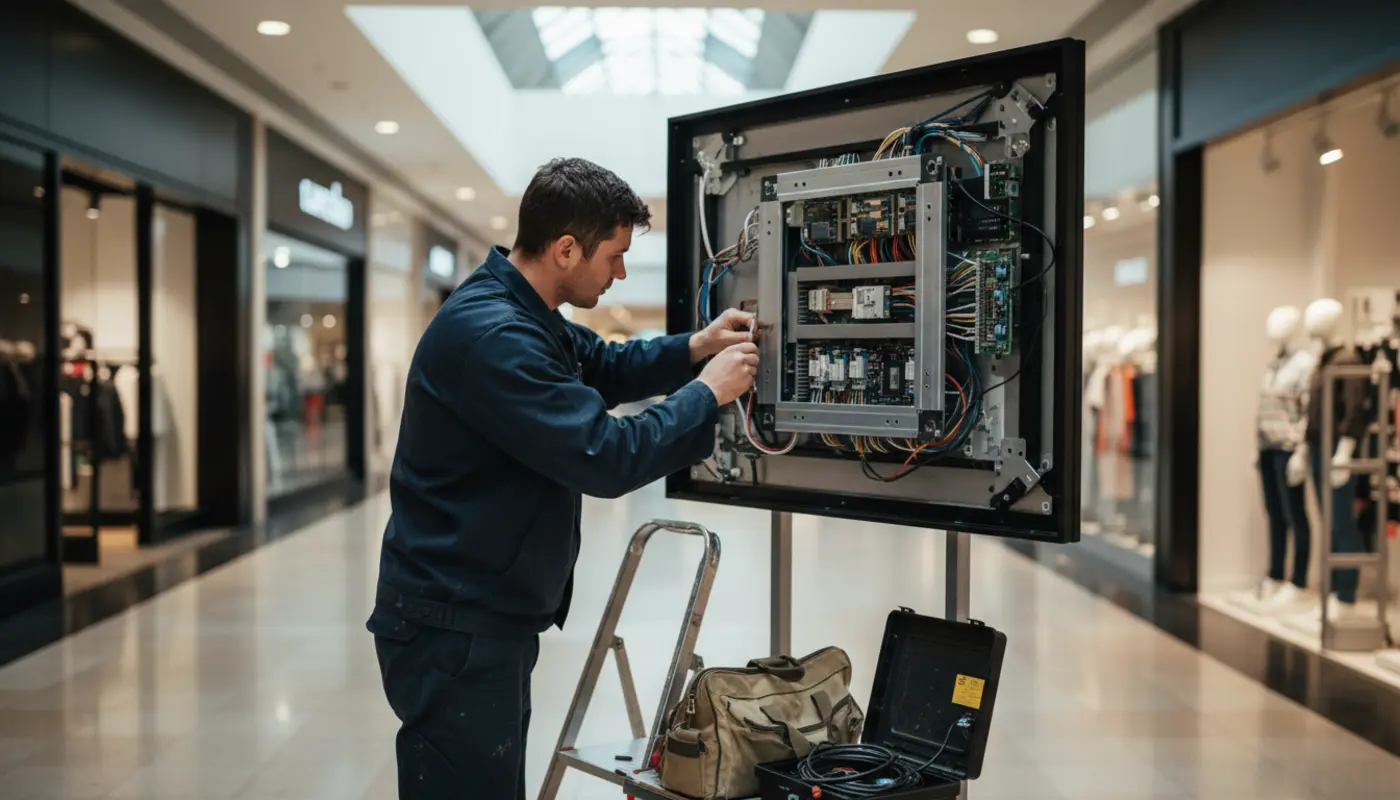
Stop pretending a few HDMI cables and a media player count as a network. They do not. A proper multi screen setup needs structured cabling, managed switches and clear documentation.
We deliver this through our business security and AV solutions framework. Every system is tested and signed off. Guesswork is not a plan.
Types Of Digital Screens Used In Shopping Centres
Not all screens are equal. And no, the cheapest panel online is not a solution.
In shopping centres we commonly install:
Large format LED walls at main entrances for brand campaigns and seasonal promotions.
Freestanding digital totems along walkways for wayfinding and adverts.
Interactive kiosks for directories and store searches.
Window facing high brightness screens that handle glare properly.
Menu style displays in food courts.
Screen choice depends on viewing distance, light levels, mounting structure and footfall. It is basic AV planning. Not guesswork.
Wayfinding And Directory Screen Solutions
Ever seen shoppers walking in circles looking for a shop? That is lost time and lost spend.
Digital wayfinding screens fix that. Clear maps. Search tools. Live updates when tenants change. No stickers covering old names.
UK guidance on wayfinding confirms that good signage improves navigation and user experience in large buildings. Busy shopping centres are no exception.
Interactive directories also provide data. Which stores are searched most. Which entrances are busiest. Useful insight when managed correctly.
We often link directory screens with access control systems and CCTV. Facilities teams then manage security and visitor flow together.
Planning And Building Regulations For Screen Installation
Now for the part people ignore. Planning.
You cannot bolt a giant LED wall to your façade and hope no one notices. External digital screens usually fall under advertisement consent rules.
GOV.UK explains advertisement control clearly. Illumination, size and position matter. Councils can require express consent depending on location and scale.
Inside the centre, structural loading, fire escape routes and listed building rules may apply. Cut corners here and you create problems.
When centres upgrade life safety systems, we coordinate with fire safety system installations. Screens must not block detection devices or evacuation routes. Compliance with BS 5839 for fire alarms, BS 5266 for emergency lighting and BS 5306 for fire extinguishers remains essential. Fire risk assessments under PAS 79 and BAFE SP101 portable extinguisher servicing standards also need to be considered.
Network Infrastructure And Connectivity Requirements
If your network is unstable, your screens will be too. A frozen advert during peak hours looks amateur.
Large shopping centre networks need structured Cat6 or fibre backbones, managed switches, rack cabinets, UPS protection and secure remote access.
Our engineers follow BICSI best practice for network cabling. Every installation is Fluke Certified. You receive as built drawings and test results at handover. No mystery cables.
Where signage links with surveillance or monitoring, systems must align with EN 50131 where integrated intruder signalling is involved. Typically this is Grade 2 or Grade 3 depending on risk. If alarms or monitored CCTV connect for security response, SSAIB certification is required for Insurance Approved status and Police Response URN eligibility.
This is not red tape. It keeps insurers on side.
For long term reliability, many centres choose planned service contracts. Because waiting for a black screen on Black Friday is not a strategy.
Content Management And Remote Scheduling
This is where things either run smoothly or fall apart.
A proper CMS lets you schedule by time, date, zone and campaign. Morning coffee ads in the food court. Weekend fashion near anchor stores. Emergency messages centre wide when needed.
We set up role based access. Marketing controls content. Facilities manage hardware. IT controls network permissions.
And yes, you can override everything for urgent safety messages. A digital network must support operations, not just advertising.
Advertising Revenue From Digital Signage
Let’s talk money.
A centre wide digital signage network becomes retail media space. Tenants pay for premium slots. Local brands buy exposure. Campaigns rotate automatically.
This turns screens into income generating assets. But only if uptime is high, impressions are tracked and content looks professional.
We help clients build packages with reporting and uptime monitoring. Advertisers do not pay for blank screens.
GDPR And Camera Enabled Signage Compliance
If your screens use cameras for analytics, pay attention.
The ICO is clear on CCTV and video surveillance. You need a lawful basis. Clear signage. Data minimisation. Defined retention periods.
That means visible notices, proper privacy policies and controlled access to footage.
If analytics link with security monitoring, installation should be by an SSAIB certified and Insurance Approved provider. This protects compliance and supports Police Response URN eligibility where connected alarms or perimeter detection are involved.
In a public shopping centre, this is not optional.
Costs And Procurement For Shopping Centre Screen Installation
Bluntly, costs vary.
A small group of 5 to 10 screens with basic CMS may start in the tens of thousands. A full multi screen network with LED walls, fibre backbone, structural works and integration can move well into six figures.
Costs cover hardware, mounting structures, electrical works, network cabling, CMS licences, planning applications and maintenance.
Procurement teams compare technical specifications, warranties, SLA response times and compliance credentials.
If you want to see how detailed compliance can get, review our SSAIB approved warehouse CCTV guide. Large retail estates expect the same level of control.
Choosing A Digital Signage Contractor In The North West
Cut the nonsense. Mounting a TV on a wall does not make someone a digital signage contractor.
You need a provider who understands planning rules, network infrastructure, structural loading, electrical compliance, maintenance and security integration.
Where signage connects with intruder alarms, systems must align with EN 50131 standards. Usually Grade 2 or Grade 3 for commercial sites. For monitored alarms, SSAIB certification is essential for Insurance Approved installations and to obtain a Police Response URN.
At iSecurity Solutions, we treat digital screen installation as part of a secure infrastructure. Not a standalone gadget.
Look at experience. Ask for documentation. Demand test certificates. Insist on clear SLAs. If a contractor cannot explain their network design in plain English, move on.
The goal is simple. A reliable, scalable and revenue generating digital signage network that improves the shopping experience across the North West. Done properly, it makes money and improves flow. Done badly, it is an expensive glowing mistake.