Data Cabling for Schools in Manchester: Cat6 Network Points for Classrooms
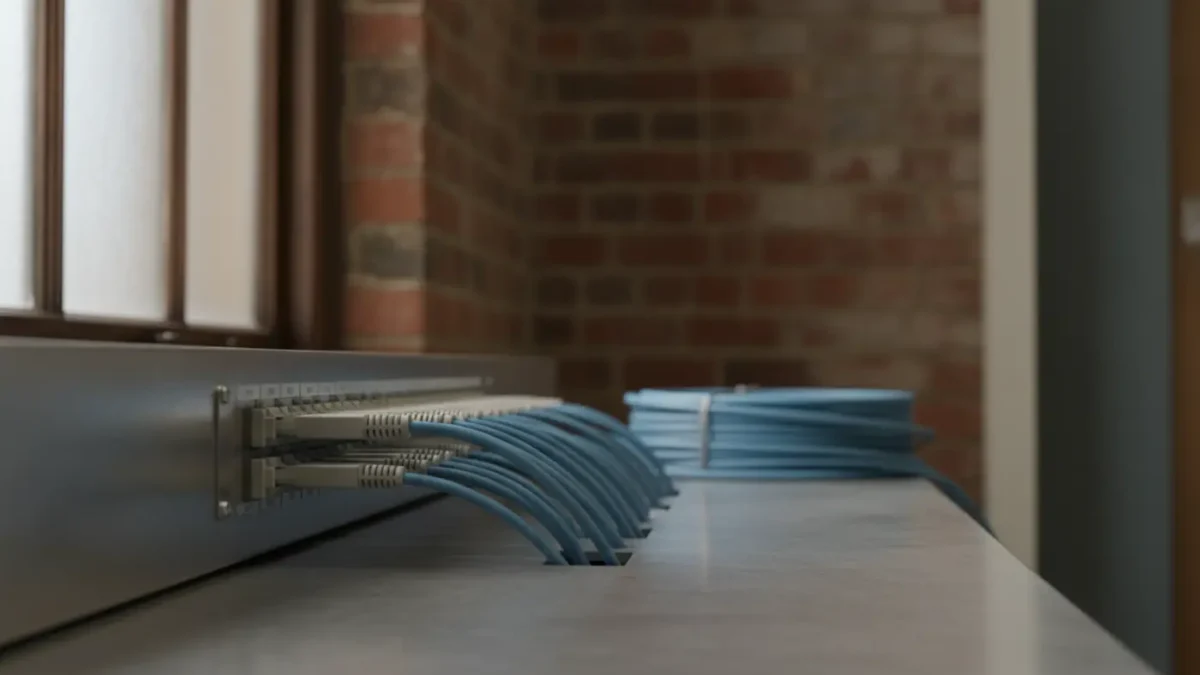
Let’s be real. Schools run on WiFi and cloud apps now. But none of that works without solid cabling behind the walls. If the copper and fibre are wrong, everything else falls apart.
In Manchester, school IT leads and business managers are under pressure. They need to meet DfE standards, satisfy governors, and stay on budget. No one wants to explain to Ofsted why the network failed during an online exam.
That is where iSecurity Solutions steps in. We design and install structured cabling systems that meet DfE guidance. We are BICSI and Fluke Certified. You get full as built drawings and test certificates. No guesswork. No messy comms cupboards.
Data Cabling For Schools In Manchester
Cut the nonsense. If you are planning new classroom cabling in 2026, Cat6a should be your baseline.
The Department for Education is clear. Copper runs should not exceed 90 metres for the permanent link. Installations must follow British Standards. You can read the official overview on GOV.UK network cabling guidance. It is not thrilling reading. But it matters.
In simple terms:
- 90m maximum copper runs
- No random splices
- Proper containment routes
- Fire rated cables
- Test every link
- Labelled patch panels
- Documented handover pack
Structured cabling must comply with BS 6701, BS EN 50173 and BS EN 50174. That covers design, installation and testing. If your contractor cannot explain those in plain English, that is a red flag.
Planning Cat6 Network Points Across Classrooms
Stop pretending one data point at the teacher desk is enough. It is not 2008.
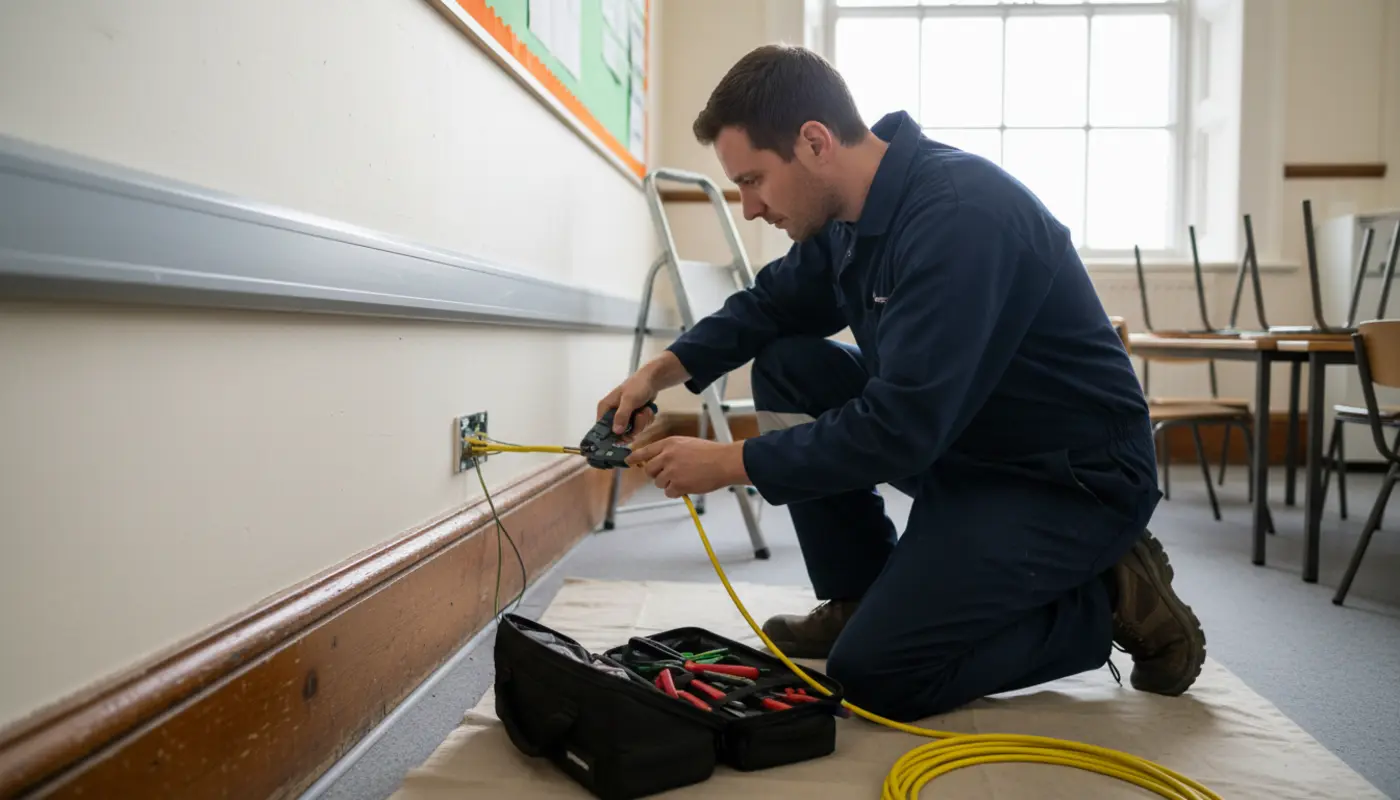
A typical primary classroom in Greater Manchester should consider:
- Teaching wall outlets
- Ceiling access point drop
- VoIP phone point
- Spare expansion ports
- Printer outlet
- Chromebook trolley zone
Secondary classrooms need even more. Science labs and ICT suites require higher density. You also need proper zoning. Cables trailing across floors are not just messy. They are a health and safety risk.
If your school already runs CCTV or access control, those systems rely on the same backbone. See how this connects in our article on CCTV for primary schools in Manchester. Same cabinets. Same infrastructure. Different devices.
Cat6 Vs Cat6a In UK Classrooms
Here’s what is actually happening. Some schools still install Cat6 because it looks cheaper. Then three years later they roll out WiFi 6, more PoE devices, and Microsoft 365 across every year group. Suddenly the cabling is the bottleneck.
Cat6 works. So does a ten year old laptop. The question is do you want to replace it in three years?
Cat6a supports 10 Gigabit Ethernet over 100 metres. It handles higher bandwidth and stronger PoE loads. That matters for ceiling mounted access points, VoIP phones and smart boards.
For primary and secondary schools in Manchester, especially those planning one to one devices or BYOD, Cat6a makes sense. We explain similar principles in our guide to ethernet cabling in Manchester offices. Install once. Install properly.
Structured Cabling Design For Primary And Secondary Schools
Look. Structured cabling is not just cables in trunking. It is a full system.
You have entrance facilities where the ISP fibre lands. Equipment rooms with core switches. Telecoms rooms across blocks. Backbone fibre linking buildings, often OM4 multimode. Then horizontal Cat6a runs to each outlet.
Victorian primaries in Manchester bring extra challenges. Thick walls. Limited containment. Asbestos surveys. All of that must be built into the design and risk assessment.
We often align cabling projects with wider infrastructure such as business security systems. Racks, power supplies and containment must allow for growth. A tidy network matters. No one wants a cabinet that looks like spaghetti.
Testing, Certification And Handover
This is where weak contractors get exposed.
Every copper link should be tested with a calibrated Fluke tester to the correct category standard. Results must be provided per outlet. Not a summary. Full reports.
As a BICSI and Fluke Certified installer, we provide:
- Full test certificates
- As built drawings
- Patch panel schedules
- Fibre test results
- Warranty documentation
- Labelled outlet maps
Your IT lead should walk into the comms room and understand it in five minutes. If they need a detective, something has gone wrong.
For ongoing support, cabling can sit under a wider security and systems maintenance contract in Manchester. That means inspections, tidy patching and proper change control when rooms are reconfigured.
Future Proofing School Networks For BYOD And Microsoft 365
Obviously device numbers are not going down. They are increasing fast.
One class set of tablets becomes one per pupil. Staff bring personal devices. Online assessments increase. Cloud storage replaces local servers. If your backbone and horizontal cabling are underspecified, you will feel it quickly.
Future proofing is simple:
- Cat6a as the baseline
- OM4 fibre backbone
- Spare cabinet capacity
- Extra access point drops
- Clear PoE budget planning
- Documented expansion routes
We cover similar scalability points in our blog on digital signage networks. When the network fails, performance drops. In schools, when the network fails, teaching stops.
Many trusts are rolling out Microsoft 365 across multiple sites. That requires consistent cabling standards. Mixing Cat5e, Cat6 and Cat6a randomly is asking for trouble. Standardise now and avoid pain later.
Maintenance, Warranty And Ongoing Support
Straight up. Cabling is a long term asset.
Quality manufacturers offer 20 year performance warranties when installed by approved contractors. That only applies if the system is registered and installed to specification. Poor terminations and tight bends can void warranties.
Annual inspections, tidy patch management and documented moves keep things under control. When you refurbish a classroom, update the drawings. Do not rely on memory.
Schools often integrate intruder alarms and access control onto the same network. Those systems must meet EN 50131 at the correct Grade 2 or Grade 3 where required. If remote monitoring or a Police Response URN is needed, installation must be by an SSAIB certified and Insurance Approved company. That certification underpins eligibility for a Police Response URN.
You can see how safeguarding systems connect in our guide to access control for primary schools in Manchester. Cabling is the hidden backbone behind it all.
Define your standards clearly. Choose experienced installers. Insist on proper testing. Future proof from day one. Do it once and do it properly. Or budget to do it twice.