PA Systems for Schools in Manchester: DfE Guidance
PA Systems For Schools In Manchester
Are you planning new PA systems for schools in Manchester and trying to understand how DfE guidance, BB93 acoustics and BS 5839 fire alarm integration all fit together?
If you are a headteacher, estates manager or MAT operations lead, it can feel like a maze of regulations, funding rules and technical standards. It is easy to feel unsure about where to begin. The good news is that once everything is explained clearly, the process becomes far more manageable and much less overwhelming.
At iSecurity Solutions, we support Manchester schools with compliant and future ready communication systems. These systems cover daily announcements, safeguarding needs and emergency response, while aligning with DfE expectations and fire safety standards.
Why PA Systems Matter Under DfE Guidance
A school PA system is not just for calling pupils in from the playground. It plays an important role in safeguarding, emergency communication and inclusive learning. No headteacher wants to discover a communication problem during a real emergency.
The Department for Education sets out acoustic expectations in BB93 acoustic design guidance, which links directly to the School Premises Regulations 2012. In simple terms, classrooms and halls must have acoustics that allow clear speech. If pupils cannot clearly hear announcements, instructions or emergency messages, the system is not doing its job properly.
Manchester schools also need to think about the practical side. Older Victorian buildings, modern extensions and modular classrooms all behave differently when it comes to sound. That is why PA upgrades are often planned alongside wider fire safety systems and structured data cabling for schools projects. Looking at everything together helps ensure performance and compliance are built in from the start.
BB93 And School Acoustics In Manchester
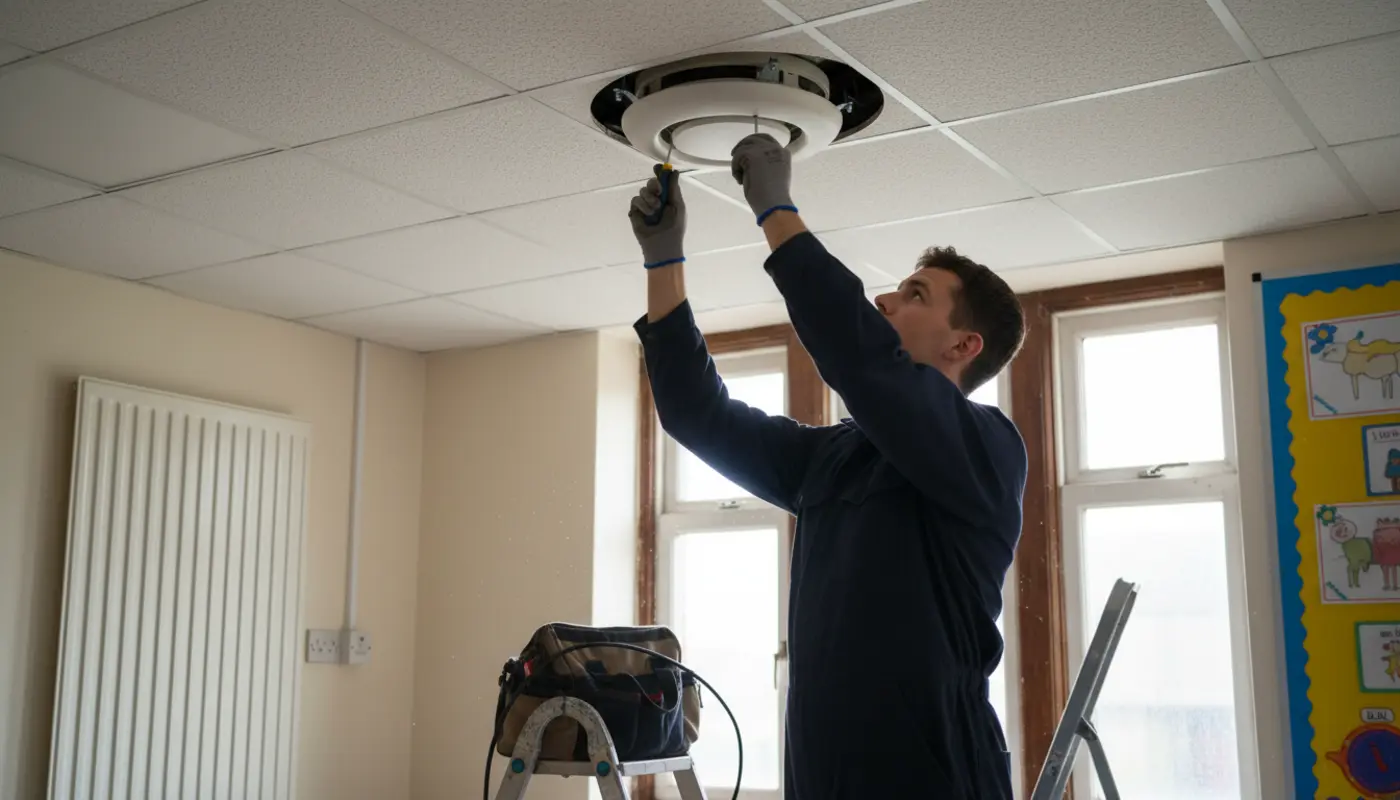
BB93 focuses on indoor background noise, reverberation times and speech clarity. While that may sound technical, the idea is straightforward. Pupils should hear speech clearly without straining, and teachers should not have to raise their voices throughout the day.
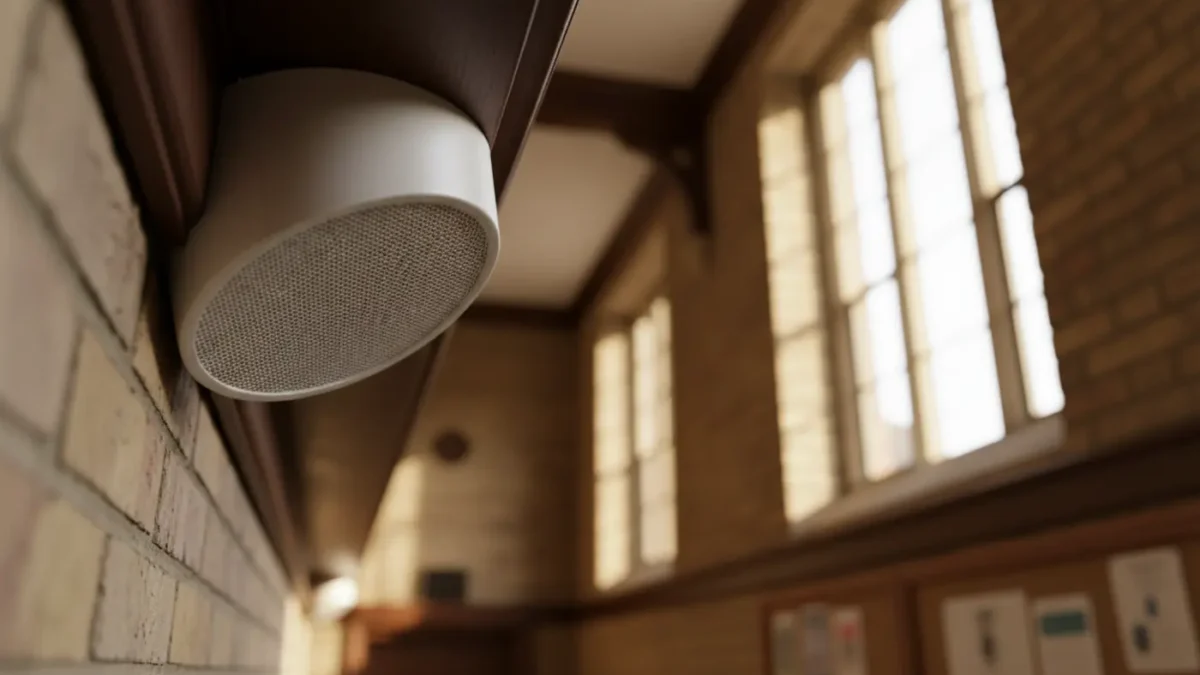
For PA systems, this means correct speaker placement, suitable zoning and volume levels that are strong enough to cut through background noise without being uncomfortable. Large halls and sports spaces usually need several evenly spaced speakers rather than one powerful unit. Corridors and stairwells also require proper coverage, especially where evacuation messages will be broadcast.
Manchester City Council planning guidance on noise may also apply if external speakers are proposed. Schools close to homes must consider sound spill and the impact on neighbours, particularly for playground announcements or evening events. Planning this properly at the start avoids complaints and costly changes later.
Fire Alarm Integration Under BS 5839 Part 8
When a PA system doubles as, or connects to, a voice evacuation system, BS 5839 Part 8 becomes essential. This British Standard covers the design, installation and maintenance of voice alarm systems that broadcast clear speech during a fire event.
In many Manchester schools, the PA system is set up so the fire alarm takes priority. If the alarm activates, it overrides music or routine announcements and plays a pre recorded or live evacuation message. Careful design and commissioning are vital here, especially in larger secondary schools with multiple zones.
Fire alarm systems themselves are designed to BS 5839 Part 1, usually Category L1 or L2 in education settings depending on the risk assessment. A detailed fire risk assessment, often aligned with PAS 79 methodology, helps determine the right category. If you want a clearer explanation of fire alarm categories in schools, what are the best fire alarms for schools explains this in more detail.
Where remote monitoring or linked security systems are involved, SSAIB certification is extremely important. An SSAIB certified and Insurance Approved installation is often required if a school needs a Police Response URN for monitored intruder systems designed to EN 50131 grades. While a PA system on its own does not generate a URN, integration with wider security infrastructure should always be considered as part of the overall site strategy.
Safeguarding, Ofsted And Premises Regulations
The School Premises Regulations 2012 state that buildings must be suitable for their intended use. Communication systems form part of that suitability. Ofsted inspections increasingly look at how well schools manage safeguarding, including emergency communication and lockdown procedures.
A zoned PA system allows selective announcements. For example, a lockdown message can be delivered internally without causing unnecessary alarm outside. Clear communication supports staff coordination and pupil safety, which sits at the heart of safeguarding duties. During inspections, schools should feel confident that their system will perform reliably when required.
Integration with access control for primary schools can further strengthen security. In an incident, doors can be secured while a clear voice message gives instructions, helping to avoid confusion and delay.
SEND Compliance And Assistive Listening
Under the Equality Act 2010, schools must make reasonable adjustments for pupils and visitors with hearing impairments. In practice, this often includes hearing loop systems or other assistive listening solutions in halls, reception areas and performance spaces.
An induction loop transmits sound directly to compatible hearing aids, reducing background noise and improving clarity. Guidance on standards and legal expectations is widely available through specialist organisations such as Ampetronic, which explain how building regulations and equality law work together.
In Manchester primary schools, loop systems are commonly installed in the main hall and at reception desks. Larger academies may require multiple loop zones. Planning this early is usually far more cost effective than adding it later.
Martyns Law And Lockdown Communication
With the development of Martyns Law, education settings are expected to strengthen their preparedness for serious incidents. Clear and reliable mass notification is central to this responsibility.
A modern PA system can deliver different messages such as lockdown, invacuation or all clear announcements. Staff can trigger messages from secure points, and some systems allow integration with mobile alerts or desktop notifications. Reviewing whether your current setup can support this level of flexibility is a sensible step.
For a wider overview of premises responsibilities, what is Martins Law explains the key points in straightforward language and highlights why strong communication systems matter.
Funding Routes For Manchester Schools
Budget is always part of the discussion. Several capital funding routes may support PA and life safety improvements, so it is worth understanding which one applies to your setting.
The DfE provides School Condition Allocation funding to eligible bodies for maintaining and improving buildings. Details are available through official GOV.UK guidance on school capital funding. Multi Academy Trusts often combine PA upgrades with wider estates programmes, particularly where safeguarding and fire alarm integration are involved.
Free Schools and academies may access ESFA grants, while maintained schools in Manchester and Salford typically work with their local authority estates teams. A clear specification that references BB93, BS 5839 Part 8 and safeguarding responsibilities can significantly strengthen the business case.
Procurement Frameworks And Approved Routes
Public sector procurement rules must be followed, although they do not have to be stressful. Many schools use Crown Commercial Service or YPO frameworks to simplify compliance and demonstrate value for money.
Using an approved framework can reduce tender time and confirm that suppliers meet financial, technical and insurance standards. It also reassures governors and trustees that the process has been handled correctly and transparently.
Typical Installation Costs In 2026
Costs depend on building size, zoning complexity and the level of fire alarm integration. As a general guide in Manchester for 2026, a small primary school may expect costs between £8,000 and £18,000 for a fully zoned digital PA system. Larger secondary schools with multiple blocks and voice evacuation integration can range from £25,000 to £60,000 or more.
For MATs reviewing several sites, combining projects can reduce costs through economies of scale. However, each building should still receive an acoustic review to confirm alignment with BB93 requirements.
Maintenance, Testing And Insurance
Once installed, the system must be maintained correctly. Where the PA forms part of a voice alarm system, inspection and testing in line with BS 5839 Part 8 is essential. Accurate records should be kept for audit and insurance purposes.
Fire alarm systems require weekly user checks and regular servicing under BS 5839 Part 1. If you are unsure about testing frequency, how often should fire alarms be tested explains the basics clearly.
Many Manchester schools choose bundled security maintenance contracts that cover fire alarms, access control and communication systems together. This approach simplifies compliance and provides a single point of responsibility, which makes day to day management much easier.
Choosing The Right Partner For PA Systems
Selecting an experienced provider is just as important as choosing the right equipment. iSecurity Solutions is a trusted UK provider of commercial and domestic security systems, supporting schools, homes and businesses with reliable protection around the clock. From CCTV and intruder alarms to fire safety, access control and construction site monitoring, systems are designed to meet British Standards and tailored to each site.
Installations involving fire alarms, voice evacuation or monitored intruder systems are delivered in line with relevant standards such as BS 5839 and EN 50131 grades, with SSAIB certification where required for Insurance Approved status and Police Response URN eligibility. Ongoing support ensures schools remain compliant, protected and confident in their systems.